

Table of Contents
ToggleI hate breaking a tradition, so let’s start with numbers I trust. Did you know that 67% of consulting revenue comes from existing clients (Business)? For some, it is not a surprise in the slightest, but still, I believe it is important to highlight once more: it’s not new prospects you have to chase. Yet few professional services businesses maintain documented client success frameworks. If you are looking for the industry’s largest missed opportunity, this is it. While the majority tries to attract new leads, market leaders build retention systems through effective success planning.
As a result, they achieve higher close rates from referrals, reduce acquisition costs, and build revenue that grows. All from their existing portfolio, which brings us to this topic I have prepared.
In this article, I will walk you through key components every customer success plan needs, the 30-60-90-day framework, KPIs that reflect retention, and AI that automates documentation. How does it sound?
What Is a Customer Success Plan?
A customer success plan is a strategic document that maps client objectives to measurable outcomes throughout the entire customer lifecycle. It defines success, assigns ownership to consulting teams and client stakeholders, and establishes proactive engagement sequences to prevent issues.
In professional services, these plans serve as contracts between consulting teams and clients, documenting business goals, technical requirements, stakeholder responsibilities, and success metrics.
What Are the Components of a Customer Success Plan?
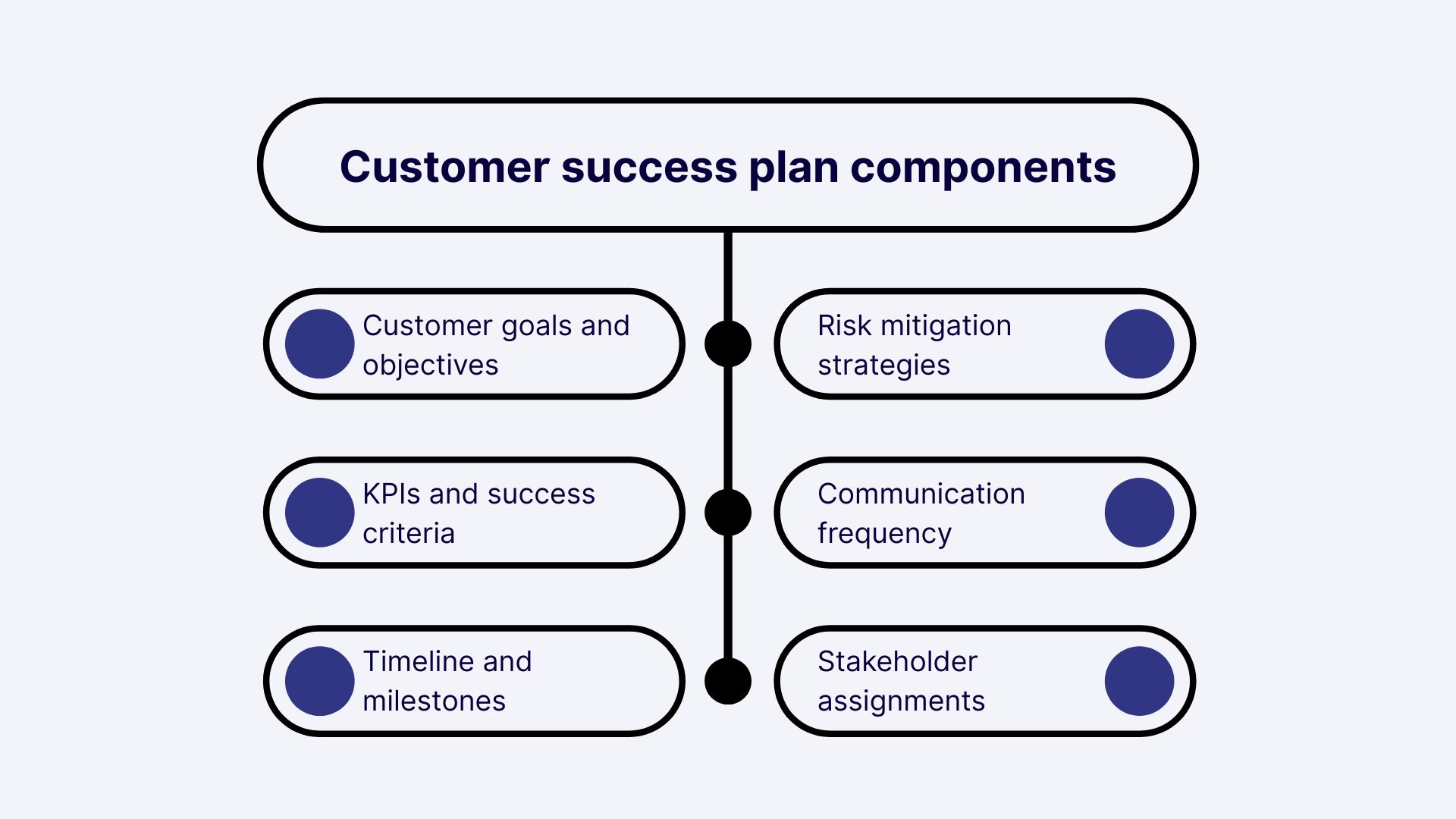
Every comprehensive customer success plan has 6 foundational components. They help create accountability, enable objective performance measurement, and ensure all stakeholders understand their responsibilities and expected outcomes.
Below, I’ve outlined key elements of a client plan:
- Customer goals and objectives: Business outcomes the client expects to achieve.
- Key performance indicators & success criteria: Measurable metrics that track progress and quantifiable thresholds that define when objectives are met.
- Timeline and milestones: Phased delivery schedule with specific checkpoints.
- Stakeholder assignments: Precise ownership for each activity, deliverable, and decision point.
- Communication frequency: Scheduled touchpoints including weekly syncs during onboarding, monthly reviews during adoption, and quarterly business reviews.
- Risk mitigation strategies: Documentation of potential threats with a predefined response plan.
What Are the Types and Frameworks of Customer Success Plans?
Professional teams select customer success plan frameworks based on 3 factors: engagement timeline, client complexity, and portfolio scale. The 4 most effective frameworks that address different priorities are 30-60-90 day plans, lifecycle-based plans, tiered plans, and account-based plans.
Let’s take a closer look at the differences between these approaches:
|
Types of Plans
|
Best For
|
Timeline
|
Typical Client Profile
|
Success Metrics
|
|---|---|---|---|---|
|
30-60-90 day plan
|
New relationships that require quick value demonstration
|
First 90 days
|
All new clients, regardless of size
|
Time to value, initial adoption %, onboarding completion
|
|
Lifecycle-based plan
|
Mature relationships at different customer journey stages
|
Ongoing
|
All active clients post-onboarding
|
Stage progression rate, renewal rate, and advocacy conversion
|
|
Tiered plan
|
Large portfolios with varying value
|
Ongoing (continuous)
|
Portfolios with 10x+ contract value range
|
NRR by tier, CSM efficiency, LTV:CAC ratio
|
|
Account-based plan
|
Complex, high-value strategic relationships
|
Multi-year
|
$500K+ contracts, enterprise complexity
|
Custom business outcomes, executive satisfaction, and expansion pipeline
|
How Do You Create a Customer Success Plan?
Okay, now that the types and definitions are covered, we dive into the topic further and talk about the steps. To build an effective customer success plan, professionals need to follow 5 key ones.
Traditionally, I’ve prepared a more detailed overview of each step with tips and examples. Let’s dive in!
1. Gather Customer Data and Define Success
Conduct discovery to understand business objectives, technical limitations, and hidden stakeholder agendas. Talk to end users, analyze support tickets from legacy systems, and document what sales promised versus what delivery can realistically achieve. The idea is to convert raw findings into SMART goals with client stakeholders, ensuring everyone agrees on the definition of success.
Tip: Use advanced AI meeting note-takers, such as Sembly, to record discovery interviews and capture client language for future documentation.
2. Select Metrics That Predict Outcomes
Choose 5-7 measurable KPIs that align with client goals, signal when action is needed, and reflect predictive and confirmatory indicators. Focus on customer health score, adoption rate, time to value, Net Promoter Score, and expansion pipeline value. Define 3 zones for each metric: green (85-100% of target), yellow (70-84% requires investigation), red (<70% requires escalation).
In case you are unfamiliar with predictive and confirmatory indicators, I’ve prepared a brief comparison table for your convenience:
|
Type of Indicators
|
Examples
|
Focus
|
|---|---|---|
|
Predictive
|
Product usage, intensity of support tickets, sentiment trends, purchased seats/licenses in use
|
Identifying potential risks before they occur
|
|
Confirmatory
|
Net revenue retention, customer churn rate, net promoter score, customer lifetime value
|
Validates results post factum
|
3. Map Journey Pain Points
Document your standard engagement flow, including major milestones, training sessions, and phase transitions. Then, visualize the complete customer journey, identifying touchpoints, internal handoffs, potential problems, and challenging stages. Overlay this with the client perspective and map it from their point of view. And lastly, design engagement cadences that align with lifecycle needs. For example, customer onboarding requires frequent contact, adoption often benefits from coaching, and renewal concentrates on value documentation.
Tip: Use advanced transcription software to identify patterns across conversations with your clients and try to fix them proactively to avoid the same problem happening to all future customers.
4. Assign Ownership
Create RACI matrices that map every customer success plan activity to particular team members. Start by listing major activities, deliverables, decisions, and milestones from your journey map. Then, identify specific people who fill RACI roles for each item. Assign owners to each deliverable and decision point on both the client and consulting sides, and document explicit dependencies. This will help professionals understand when one person’s work must be completed and define escalation paths.
Here is a brief RACI reference:
- Responsible: Who does the actual work to complete the task?
- Accountable: Who is responsible for completion and has approval authority?
- Consulted: Who can provide input and expertise before decisions or actions happen?
- Informed: Who should be kept updated on progress and outcomes after decisions are made?
5. Automate Health Monitoring and Alerts
Connect your customer success platform to relevant data sources, including service delivery systems, CRMs, billing apps, and survey tools. Then, set up a customer success platform (or integrations) to monitor usage, support activity, engagement, and financial signals. Lastly, combine these inputs into customer health scores that update daily or weekly, and set up automated alerts to notify your team when scores drop or concerning trends change.
Now that you know the theory, I suggest that we briefly review the alert examples:
|
Data Source
|
Tracked Signals
|
Alert Trigger
|
Action Example
|
Business Impact
|
|---|---|---|---|---|
|
Usage analytics
|
Login frequency, feature adoption, session duration
|
Login activity declines ≥30% over 14 days
|
Review adoption data and identify blockers within 3 business days
|
Signals churn risk 6-9 months before contract renewal
|
|
Customer sentiment
|
NPS, CSAT, qualitative feedback
|
NPS score drops from ≥8 to ≤5
|
Schedule a diagnostic call within 48 hours
|
Shows dissatisfaction before it escalates
|
|
Engagement signals
|
Meeting attendance, email response rate, and touchpoint participation
|
Two meeting cancellations or no-shows
|
Conduct direct outreach to re-engage within 5 business days
|
Detects relationship disengagement early
|
|
Support tickets
|
Ticket volume, severity, resolution time, repeat issues
|
≥3 Severity 2 tickets within 7 days
|
Escalate to technical lead
|
Prevents unresolved issues from impacting churn
|
These five steps work focus on different aspects of customer relationships and ensure professionals fix problems proactively, reduce execution gaps, and minimize spreadsheet work.
What Are the Best AI Tools for Customer Success Planning?
It is no secret that many teams, especially in consulting, manage different projects simultaneously and often turn to AI to optimize their workflows. It’s not that professionals cannot work without tools, no. However, the best solutions for success planning ensure that they do it effectively.
Below, you’ll find the top 3 tools that will help create successful client plans. Shall we get started?
Sembly for Meeting Analysis and Documentation
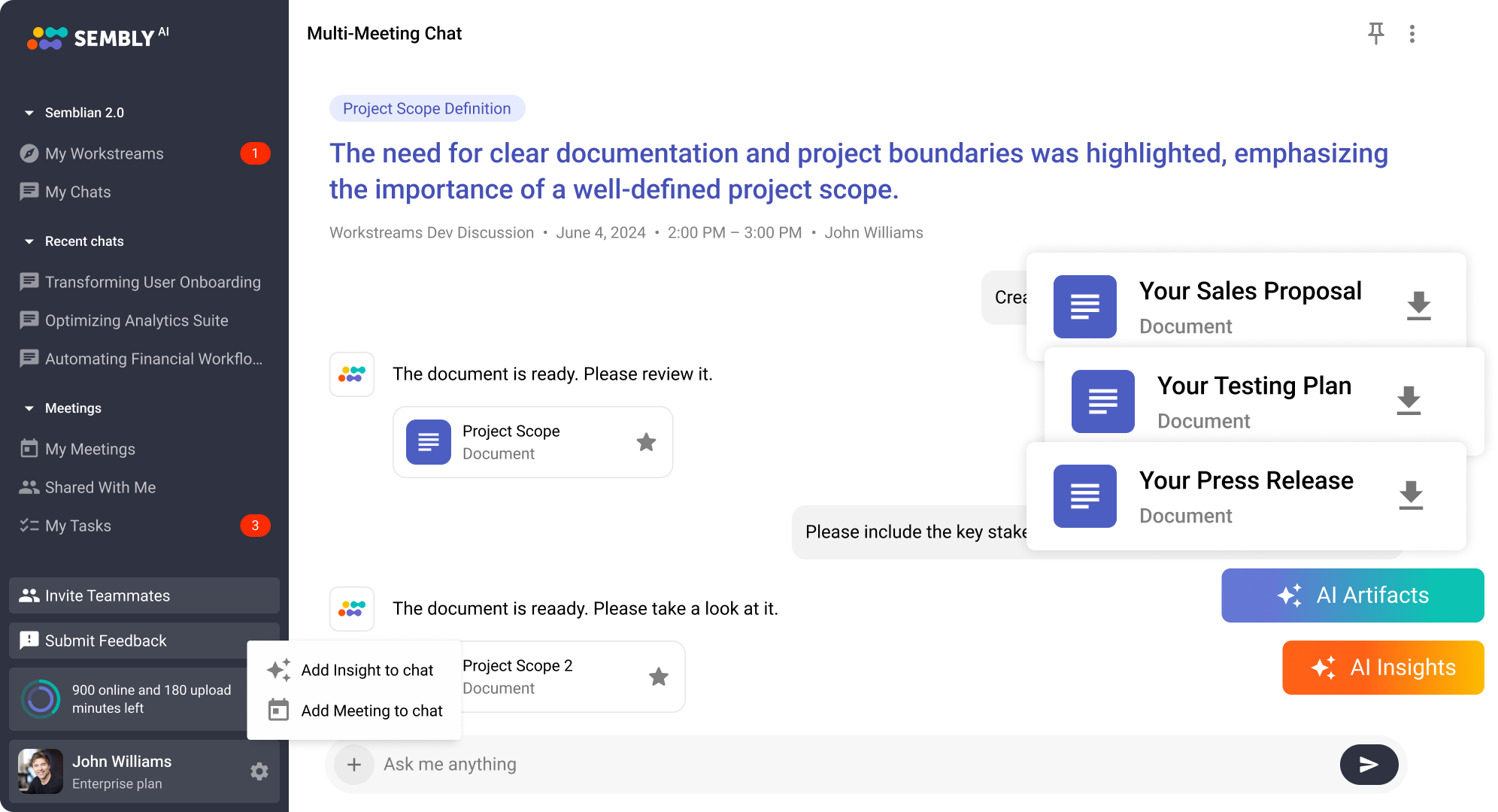
Sembly is the best AI meeting assistant that automatically records, transcribes, and analyzes customer success touchpoints, including onboarding calls, quarterly business reviews, and executive briefings. It captures action items, decisions, commitments, and risks, and drafts documentation based on the meeting content. Sembly’s sentiment analysis detects dissatisfaction or concern in client language even when stakeholders don’t explicitly voice complaints, flagging potential issues for consulting or customer success teams.
Key Features
- Automated project deliverables based on the meeting content
- Transcription in 45+ languages with high accuracy and speaker identification
- Sentiment analysis identifying frustration, concern, or excitement in client language
- Automatically extracted risks, notable events, and achievements
- Direct integration with task and project management software, CRMs, communication tools, and analytics applications
- Searchable conversation archive across all meetings
Best for
- Customer success teams that manage multiple accounts and can’t document every conversation
- Professional teams that want to optimize relationship continuity when consultants rotate
- Global consulting agencies with multilingual client conversations
ChurnZero for Customer Health Monitoring
ChurnZero is a customer success platform that calculates real-time health scores. It combines product usage, support tickets, email engagement, and custom metrics into a single 0-100 number predicting churn probability. The platform’s playbook engine automatically triggers CSM tasks, email sequences, or stakeholder outreach when accounts meet specific conditions. The tool also tracks the account position in the customer journey, adjusting engagement cadence based on the lifecycle stage.
Key Features
- Real-time health scores that combine usage, support interactions, engagement, and payment data
- The ChurnScore algorithm that predicts individual account churn probability
- Journey stage tracking from onboarding through adoption, renewal, and advocacy
- In-app messaging that sends surveys, tips, or announcements directly to end users
- Portfolio analytics that reflect health distribution and revenue at risk
Best For
- Companies that manage accounts and require automated monitoring
- SaaS professional services that track product usage as an adoption indicator
Totango for Workflow Automation at Scale
Totango is a customer success platform that automates repetitive workflows through pre-built playbooks and templates. It monitors customer behavior across product usage, email engagement, support interactions, and payment signals, and automatically triggers specific actions. It also segments customers by health score, lifecycle stage, product tier, contract value, or any custom attribute, applying different engagement strategies to each segment.
Key Features
- Library with pre-configured workflow templates
- Campaign designer with drag-and-drop components and HTML embedding option
- Customer segmentation by health score, usage patterns, contract attributes, or engagement metrics
- Health score calculator that combines usage frequency, feature adoption depth, support ticket volume, and stakeholder engagement
- Campaign performance analytics that track open rates, click-through rates, and conversion metrics
Best For
- Growing businesses that require automation infrastructure
- Customer success teams that need to optimize their routine workflows
What Are the Use Cases and Results of AI in Customer Success Planning?
Customer success AI tools usually help optimize key activities, such as predicting churn, analyzing sentiment in conversations, automating routine tasks, and drafting personalized follow-ups after meetings. Furthermore, agentic software seems to be gaining popularity, with 14% of teams already adopting these tools (Gainsight).
Here are some of the statistics showing the use cases and results of customer success AI software:
- 54% of client success managers already use AI for sentiment analysis to assess customer satisfaction (Gainsight).
- Specialists using ChurnZero report a 2x increase in customer lifetime value and 100% increase in account growth (ChurnZero).
- Companies using Totango report a 222% increase in user engagement (Totango).
- 71% of customer success teams use AI tools to draft email follow-ups (Gainsight).
- Around 39% of professionals use AI for improved churn or risk predictions (Gainsight).
Businesses implementing AI platforms report quantifiable gains in retention rates, customer lifetime value, and CSM productivity. Overall, the data shows a high level of AI adoption in customer success, with over half of teams now using AI for at least one core function.
Wrapping Up
Effective customer success plans separate consulting companies that constantly chase new business from those that build compounding revenue from existing relationships. The key? Gather intelligence, select predictive metrics, map pain points proactively, assign clear ownership, automate monitoring. This gives you the structure to scale personalized engagement across growing portfolios without hiring proportionally.
In this article, we’ve examined the definition of a customer success plan, studied its types and key components, reviewed creation steps, as well as discovered the top 3 AI tools to optimize customer success planning workflows. I hope you’ve enjoyed this guide. Good luck winning customers over!
FAQ
What is a customer success plan?
A customer success plan is a documented strategy that maps client business objectives to specific deliverables, assigns ownership to both consulting and client teams, defines measurable success metrics, and establishes proactive touchpoint schedules throughout the customer lifecycle.
The plan includes customer goals, key performance indicators, timeline with milestones, stakeholder assignments using RACI matrices, communication cadence, risk mitigation strategies, and success criteria.
What are the benefits of customer success planning?
Customer success planning delivers three quantifiable benefits: higher retention rates by detecting churn risk 6-9 months early, systematic expansion revenue.
Here are some of the operational improvements:
- relationship continuity when team members transition
- predictable revenue forecasting
- CSM productivity gains
- proactive value delivery
- executive alignment
How do you choose an AI tool for customer success planning?
Choose AI tools based on three factors: which specific customer success gap you need to solve, your portfolio size and CSM-to-account ratio, and integration requirements with existing systems.
Here are the steps to choose an AI tool by primary need:
- Meeting intelligence: Prioritize Sembly AI. It captures and analyzes client conversations, extracts key details, and automates documentations.
- Health monitoring: Choose ChurnZero. It helps success and consulting specialists automate scoring and alerts
- Workflow automation: Consider Totango. It helps professional teams handle routine touchpoints
What are the common mistakes in customer success planning?
Here are some of the common mistakes in customer success planning:
- Building success plans without scheduling quarterly reviews to update them as circumstances change.
- Starting implementation without measuring current performance.
- Using monthly check-ins everywhere when onboarding needs daily contact and renewals need weekly attention.
- Measuring activity of customer success managers instead of adoption rates or business impact.
- Applying identical customer success processes to all contracts.
- Multi-meeting chats
- AI Insights
- AI Artifacts

You might also like
