
Table of Contents
ToggleHow much time do your HR professionals spend on repetitive tasks that could be automated? As it appears, businesses that implement agent-like AI report a 63% increase in productivity, as well as 52% overall improvement in employee efficiency (Devstark). The question here isn’t whether AI works; no, it’s why 60% of HR teams still haven’t adopted it (Moorepay).
The answer often lies in confusion about implementation. Professionals understand AI’s potential but struggle to find tools that fit their workflows and job nuances. They’ve experimented with AI chatbots that answer questions or summarize policies, but these tools stop at text generation. As a result, specialists in human resources end up completing the majority of tasks manually, unaware of more effective ways to handle them with artificial intelligence.
In this article, we will examine what agent-like AI is, how it differs from traditional AI in human resources, and which proven solutions with autonomous capabilities lead to the best results. Let’s get started!
What Is Agent-Like AI?
AI with agent-like capabilities refers to systems that support decision-making and workflow execution. They combine automation, contextual understanding, and multi-step reasoning. Unlike fully autonomous agents, these tools typically operate with human initiation and oversight, reducing manual work, surfacing insights, and supporting consistent execution.
Example: Sembly captures meeting discussions during candidate interviews or employee performance reviews, identifying key qualifications, growth areas, and mentioned concerns.
What Is the Difference Between Traditional AI and Agent-Like AI?
|
Aspect
|
Traditional AI
|
Generative AI
|
AI with Agent-Like Capabilities
|
|---|---|---|---|
|
Main Function
|
Follows predefined rules
|
Generates text content, images, or code pieces
|
Combines automation, context awareness, and multi-step reasoning
|
|
Decision-Making Process
|
“If X, then Y” logic
|
Pattern-based outputs
|
Contextual signals and structured inputs
|
|
Adaptability
|
Manual
|
Based on prompts
|
Adapts within defined workflows based on data, rules, and human guidance
|
|
Scope of Work
|
Single predefined tasks
|
Content generation
|
Automates and assists multiple workflow steps with human oversight
|
The key difference between traditional AI, generative AI, and AI with agent-like capabilities lies in how they support tasks and workflows. Traditional AI automates rule-based processes such as resume parsing or ticket routing. Generative AI brings natural language understanding and content creation. AI with agent-like capabilities retains context, supports multi-step workflows, and helps teams execute tasks more consistently. Overall, these systems assist with planning, analysis, and coordination.
What Is the Impact of Agent-Like AI on HR Practices?
AI systems with agent-like capabilities help HR teams improve routine workflows, allowing them to focus on tasks that require human judgment. These can include identifying unengaged talent before they resign or building a team culture that retains top performers. Overall, the transformation reshapes 3 core areas of HR work:
- Employee onboarding and training: AI, along with human resource professionals, helps in developing training modules that are more visually engaging. AI can also help translate video training content, making it easier to onboard remote teams across different countries by ensuring everyone can access materials in their own language.
- Employee engagement and retention: Agent-like AI tracks engagement signals, such as participation in internal activities or use of the benefits package, to surface patterns that indicate retention risks.
- Employee performance management: AI with agentic capabilities can collect information from project tools, pull CRM performance data, and use peer feedback to provide managers with a complete picture.
- Learning and development: AI systems can highlight skill gaps based on role requirements and available data. They can also recommend relevant courses or mentorship opportunities, send reminders, track completion, and generate AI reports.
As a result, agent-like AI expands what HR teams can accomplish. It handles routine, giving HR professionals the time and data they need to focus on initiatives that positively influence employee experience and business outcomes.
What Are Examples of Agent-Like AI in HR?
Now that you understand the definition and role of agent-like AI in human resources, I suggest that we move further and review software examples. Below, you will find solutions that represent proven implementations of agent-like AI. Each tool addresses specific pain points, so hopefully, by the end of this list, you will have identified the best fit and the next addition to your toolset.
1. Sembly AI for Meeting Intelligence and Documentation
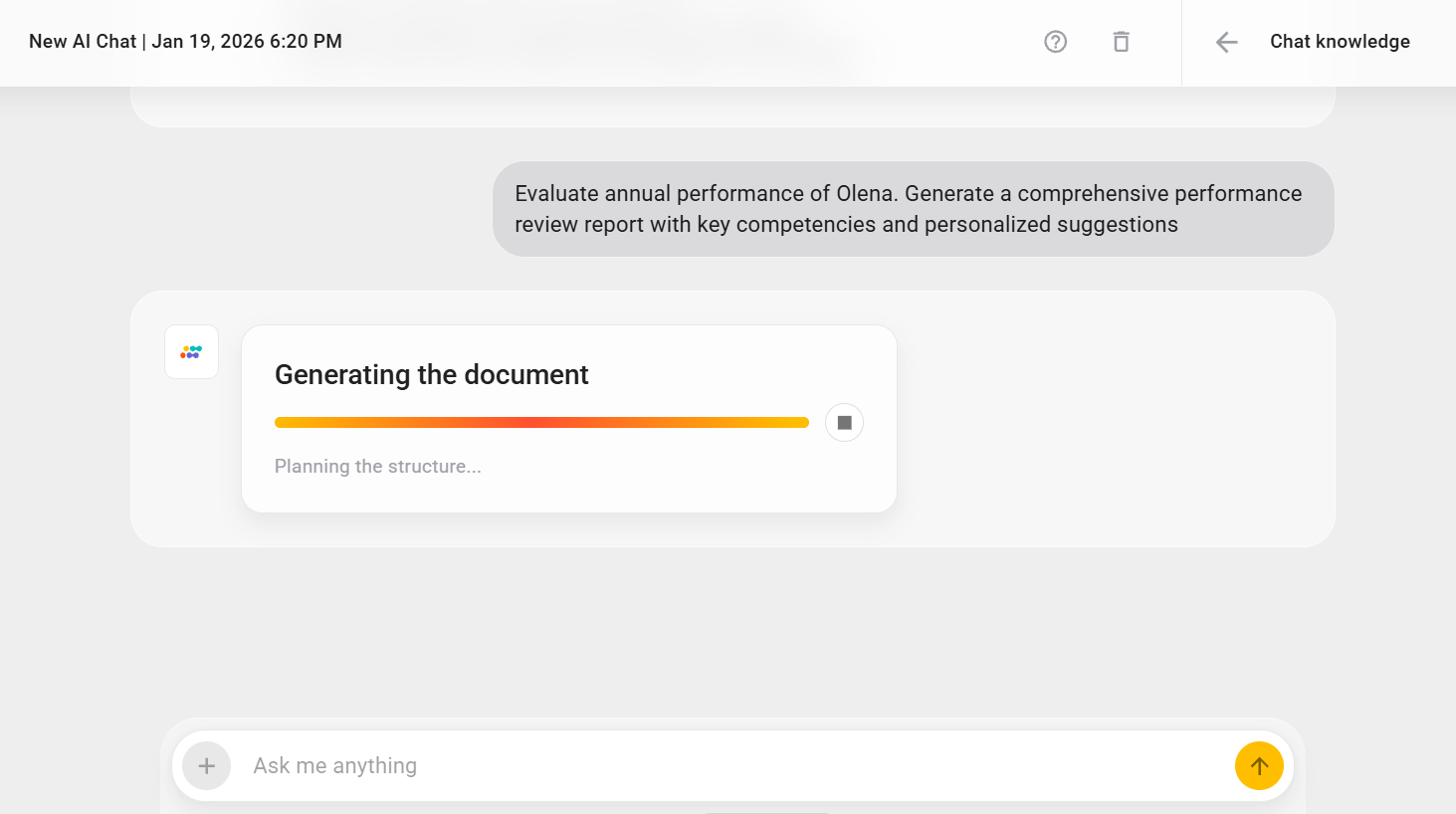
Sembly is an advanced AI meeting assistant that helps HR professionals capture and act on meeting content. It records meetings, extracts action items, generates searchable transcripts with speaker identification in 45+ languages, and automatically drafts structured documents, such as interview feedback, performance review notes, and project plans. The tool provides enterprise-grade security and complies with standard regulations to ensure candidate data is safe.
Key Features
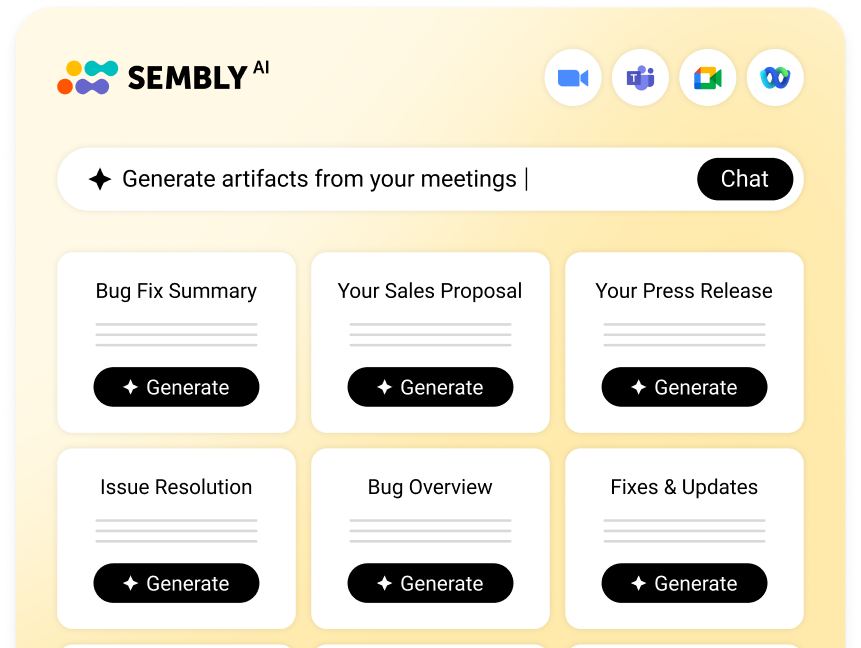
- AI artifacts: Automatically drafts downloadable business documents in DOCX, PDF, HTML, or Markdown formats based on meeting content.
- Personalized insights: Analyzes user role and meeting context to recommend relevant document types and next actions.
- Meeting notes & summaries: Creates structured summaries with speaker identification, key decisions, and action items automatically extracted from conversations.
- AI tasks: Identifies and creates a list of tasks with their descriptions, deadlines, assigners, and assignees.
- Collections: Lets users organize related meetings by client, project, or workstream for improved structure and navigation.
- Multilingual transcriptions: Supports 45+ languages with accurate transcription, helping global HR teams document meetings regardless of the language.
- Sentiment analysis: Detects emotional tone in conversations to flag potential concerns during syncs about self-evaluation results, exit interviews, or employee feedback sessions.
2. Workday Skills Cloud for Skills-Based Talent Management
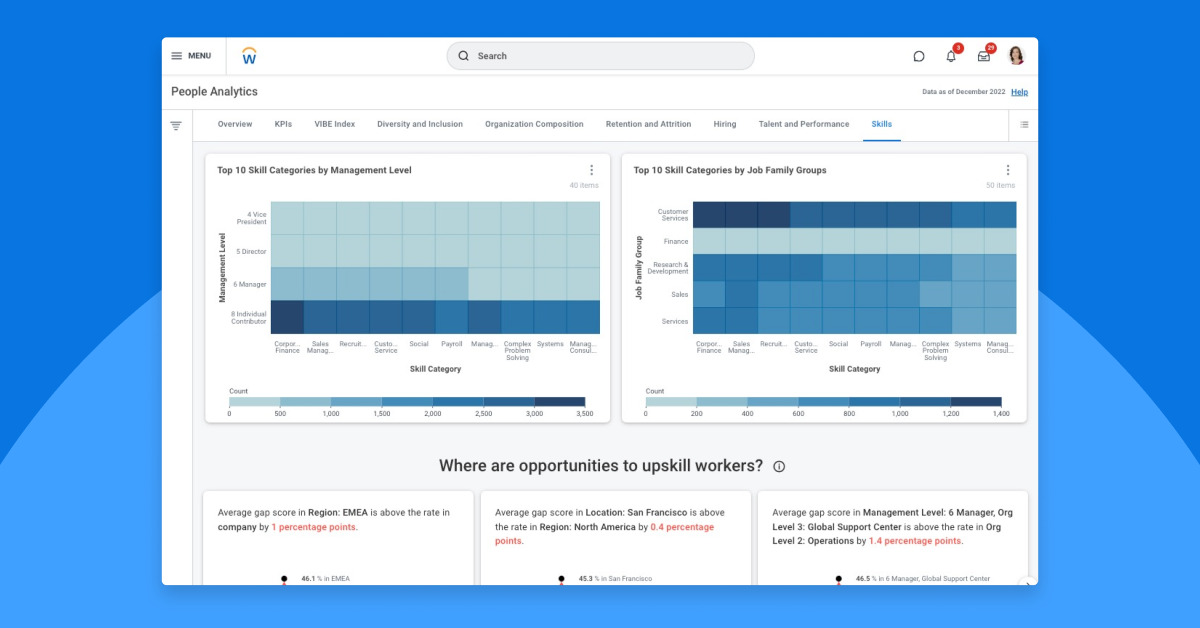
Workday Skills Cloud uses machine learning algorithms to map employee skills, identify development opportunities, and match internal talent to open positions inside the company. The AI analyzes data from multiple sources, such as completed projects, training certifications, managerial assessments, and peer feedback, to build comprehensive profiles. It also integrates with LMS to automate enrollment, track progress, and verify skill acquisition.
Key Features
- Opportunity matching: Matches employees to internal projects and full-time roles based on skill alignment and career goals.
- Skills gap analysis: Compares current workforce capabilities against future business needs to identify organizational skill shortages and recommend development strategies.
- Learning recommendations: Suggests specific courses, mentors, and stretch assignments for each employee’s skill gaps and career goals.
- Succession planning: Analyzes skill readiness and career trajectory, flagging succession risks before key positions become vacant.
3. Eightfold AI for Talent Acquisition
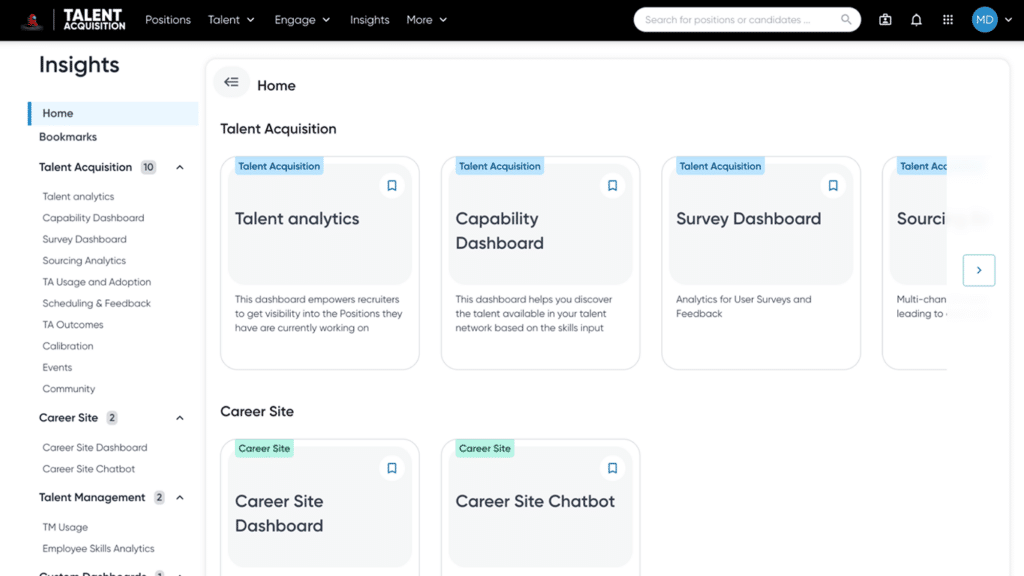
Eightfold AI applies deep learning to predict candidate success, employee retention risk, and internal mobility opportunities. The platform’s AI makes independent decisions about candidate screening, interview scheduling, and offers based on patterns in historical hiring data and market trends. It can also identify gaps in current workforce capabilities, model different talent acquisition scenarios, and recommend hiring or redeployment strategies.
Key Features
- Rediscovery of talent: Finds past applicants and internal candidates for new roles based on evolved skills and experience.
- Diverse hiring: Identifies diverse candidate pools by removing bias and surfacing qualified candidates from underrepresented backgrounds.
- Career path mapping: Maps potential career trajectories for employees by analyzing successful transitions across the organization.
- Retention prediction: Analyzes engagement signals, tenure patterns, and external job market activity to calculate individual risk scores.
- Skills analysis: Identifies which skills naturally cluster together and which roles require similar capabilities.
4. Visier for People Analytics
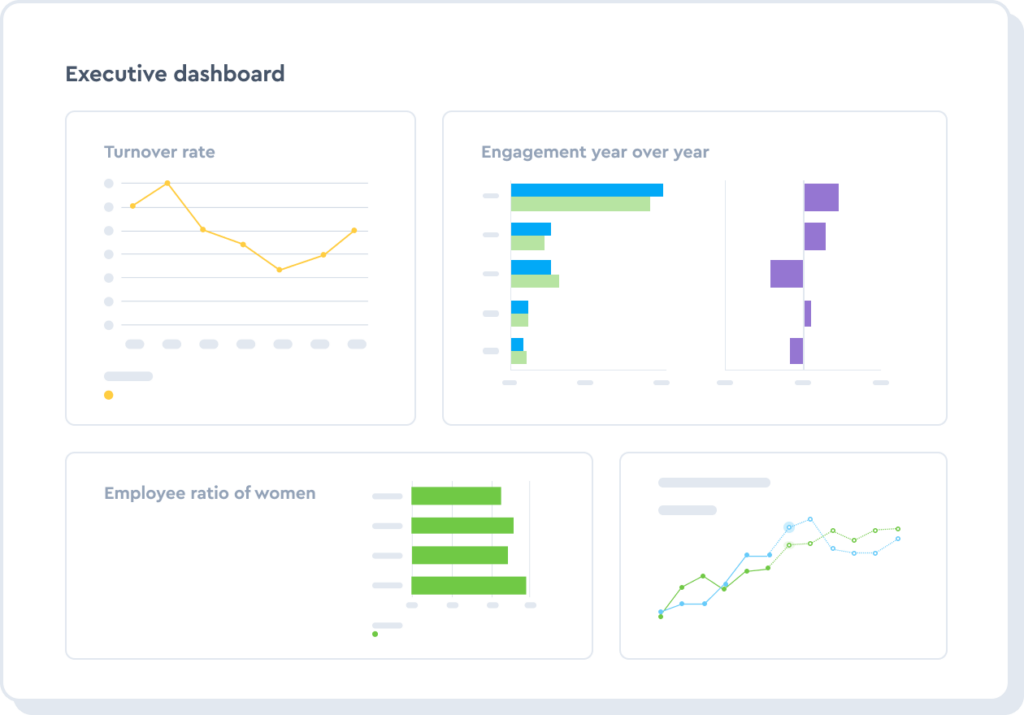
Visier is an AI-powered people analytics platform that uses data from HRIS, performance management systems, learning apps, and external market sources to identify trends in turnover, productivity, and engagement. The AI identifies departments with unusually high attrition rates, teams where performance metrics are declining, diversity metrics that do not progress, and skill gaps that will impact future business objectives.
Key Features
- Predictive analytics: Analyzes historical exit patterns, engagement scores, and tenure data to forecast which employees are likely to leave.
- Headcount planning: Calculates optimal staffing levels by department and role based on business growth targets, budget, and historical productivity levels.
- Pay equity analysis: Identifies compensation disparities across demographics, roles, and locations.
- Manager effectiveness scoring: Evaluates leadership performance based on team retention, engagement from employee surveys, productivity, and promotion rates.
- Engagement correlation: Links engagement survey data to business outcomes, such as productivity, quality, and retention.
5. Leena AI for Employee Engagement and Support
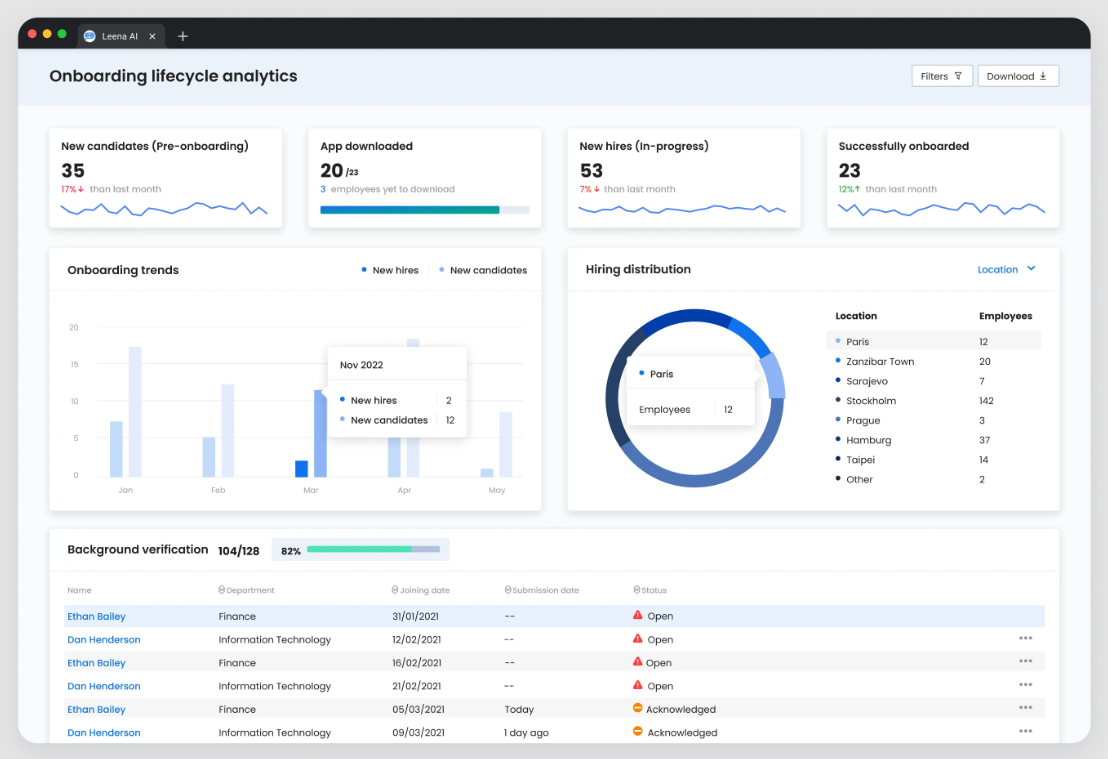
Leena AI is a conversational AI in HR that handles employee questions and requests across departments through natural language interactions. The platform integrates with the backend, functioning as a virtual assistant that resolves employee needs without human agent intervention. The tool learns from every interaction, improving its ability to understand regional language variations, handle critical cases, and resolve complex requests.
Key Features
- Conversational self-service: Processes employee requests through natural language chat across Slack, Teams, email, or web interfaces.
- Intelligent escalation: Automatically routes complex questions to appropriate HR specialists with full conversation history, context, and suggested resolution paths.
- Multilingual support: Understands and responds in 100+ languages with dialect recognition.
- Workflow automation: Manages end-to-end HR processes, such as onboarding task completion, document collection, and approval routing.
- Sentiment analysis: Analyzes tone and emotion in employee interactions to detect frustration, dissatisfaction, or urgent concerns.
6. Workforce Now for Payroll and Compliance
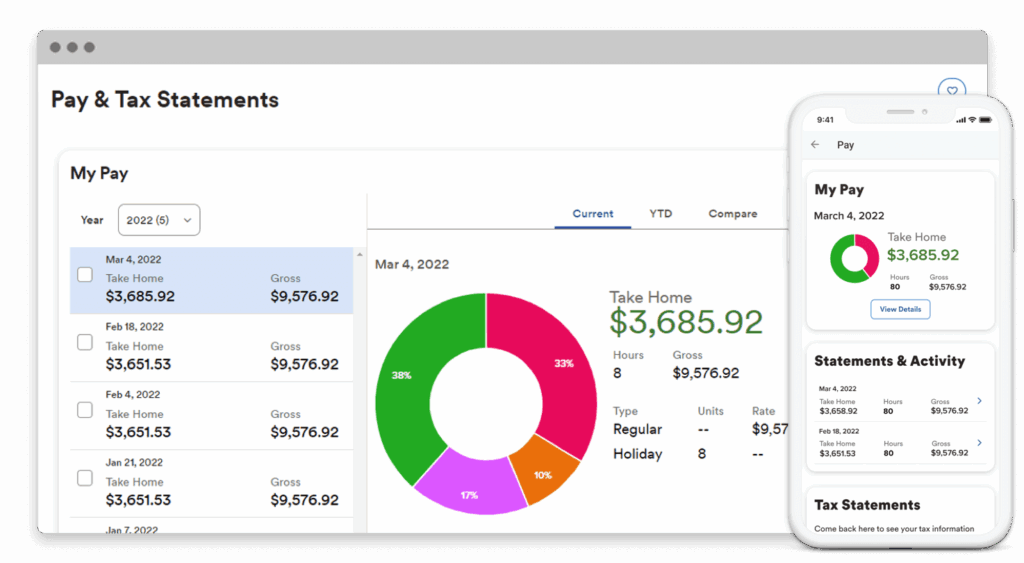
ADP Workforce Now is a comprehensive human capital management platform that integrates agentic AI across payroll processing, tax compliance, and benefits administration. It monitors regulatory changes across all applicable jurisdictions, updates withholding calculations when rates change, files required reports with federal and state agencies, alerts HR teams to update policy, and maintains audit trails.
Key Features
- Tax compliance: Monitors federal, state, and local tax jurisdictions, applying correct withholding rates, filing deadlines, and reporting requirements.
- Payroll processing: Calculates wages, deductions, and tax withholdings while flagging anomalies.
- Compliance alerts: Notifies HR professionals of regulatory changes that affect wage laws, overtime rules, or benefits requirements.
- Audit trail maintenance: Logs every payroll transaction, system change, and compliance action with timestamps and user identification.
What Are the Benefits of Integrating Agent-Like AI in HR?
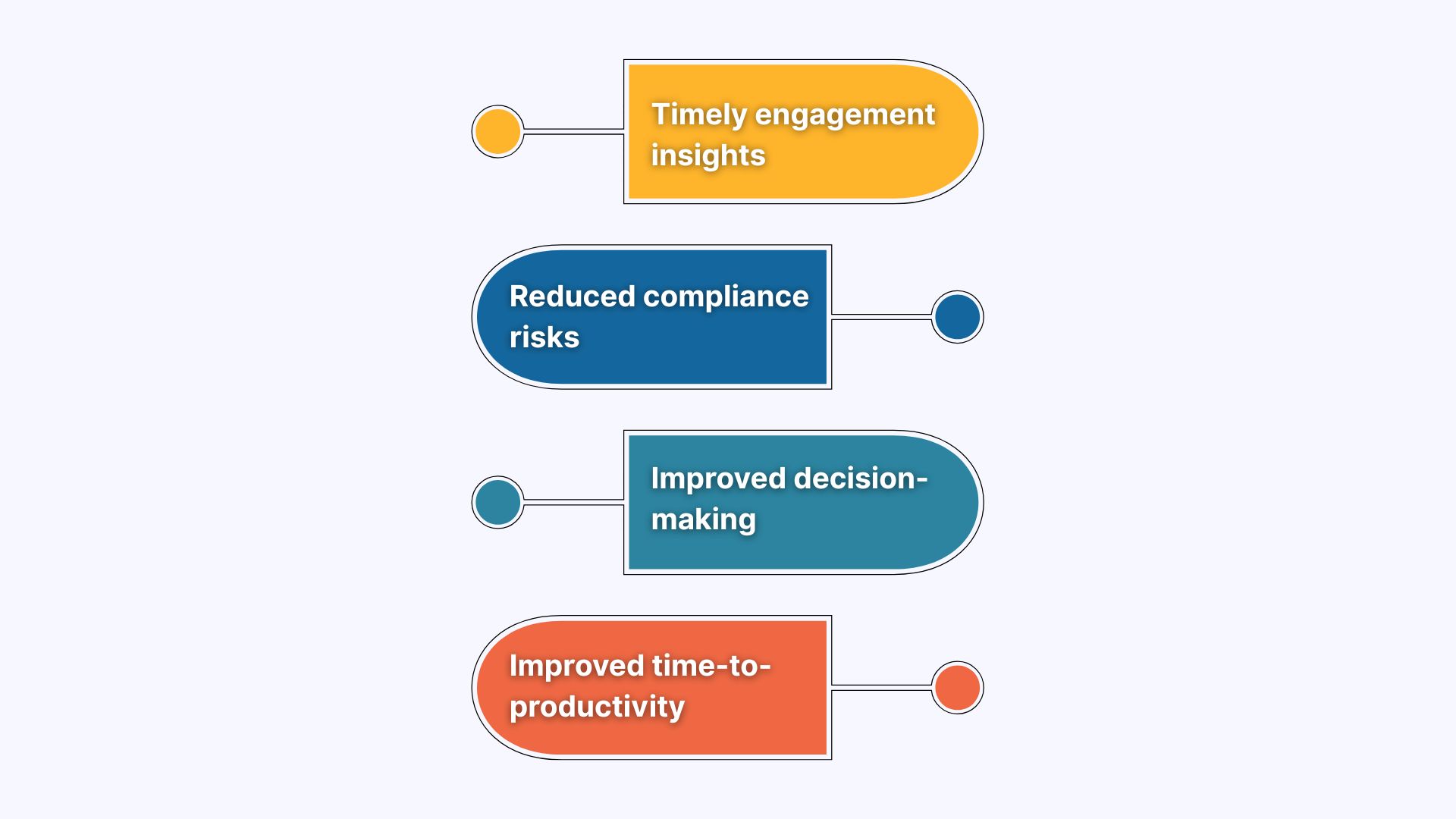
Aside from automating repetitive tasks, agent-like AI in HR has 4 strategic advantages over traditional automations. Usually, these benefits compound as AI systems learn from outcomes, improving accuracy, refining recommendations, and identifying patterns humans often overlook.
Below, I have prepared an overview of the benefits of agent-like AI in HR management. Let’s get a closer look at them!
Improved Time-to-Productivity for New Hires
New employees traditionally spend 30-60 days navigating onboarding, waiting for access, searching for materials, and asking repetitive questions. Agent-like AI compresses this timeline by managing numerous tasks simultaneously. It provides role-specific resources and guides newcomers through the onboarding process effectively. As a result, when new hires reach productivity in 2 weeks instead of 6, organizations gain 4 additional weeks of full contribution.
Tip: Use Sembly to generate personalized onboarding plans based on the relevant meeting discussions. You can also create collections to organize onboarding calls by department, role, or seniority.
Reduced Compliance Risks
Manual HR processes often create compliance risks through inconsistent policy application, missed certification deadlines, and incomplete documentation. Agent-like AI, on the other hand, reduces risks by executing every workflow identically. It applies the same eligibility rules, tracks deadlines, and maintains complete audit trails. Responsible AI practices in human resources ensure decisions are documented and aligned with organizational requirements.
Fact: Around 70% of businesses use AI for regulatory updates, with over 80% using it for risk assessments and documentation review (White & Case).
Improved Decision-Making Through Reduction of Bias
Human hiring decisions often suffer from unconscious biases, while agent-like AI applies identical criteria to every candidate. It analyzes full-year performance data instead of recent impressions and surfaces talent based on skills. Generative AI models also create job descriptions focused on competencies, setting clear expectations for candidates and attracting top talent.
Fact: Businesses using agent-like AI in human resources report hiring 19% more females by eliminating gender bias (Eightfold AI).
Timely Engagement Insights
Traditional HR tech relies on annual employee surveys and quarterly reports to monitor employee health. Agent-like AI, on the other hand, generates real-time talent insights based on employee interaction through big data analysis. Natural language processing analyzes employee survey comments for sentiment patterns that quantitative scores miss. As a result, HR teams access inefficiencies and knowledge gaps that are often overlooked.
Tip: Ask Sembly to analyze sentiment in conversations with employees, their activity, and participation in team discussions to get a better understanding of their engagement and satisfaction.
What Are the Results of Using Agent-Like AI in HR?
Overall, current agent-like AI applications in HR focus on efficiency. They help professionals automate resume screening, process benefits enrollment, and coordinate onboarding workflows. The next evolution will likely shift toward strategic intelligence, such as predictive workforce analytics, autonomous decision-making within defined frameworks, and seamless integration across HR technology stacks. However, the idea remains the same: these tools help professionals work smarter.
Traditionally, I have prepared some agent-like AI statistics that shed some light on the adoption of tools:
- HR professionals using AI employee engagement software see a return on investment in 16 months (G2).
- Specialists using Eightfold report a 24% higher quality of inbound candidates (Eightfold AI).
- Companies using AI technology in human resources achieved a 55% automation of repetitive tasks (Devstark).
- KPMG managed to reduce the number of HR queries by 50% by using a specialized AI agent (Devstark).
- HR teams using agentic AI achieved an 81% increase in internal mobility (Eightfold AI).
- IBM mentioned developing models capable of predicting 95% of employee departures before they occur (Devstark).
In conclusion, the organizational structure likely evolve as HR professionals shift from admin roles to strategic partnerships, focusing on culture, talent marketplace strategy, and change management while AI handles routine tasks.
Wrapping Up
Unlike previous automation tools that focused on making manual processes digital, agent-like AI in HR fundamentally combines reasoning, planning, and autonomous execution. The technology provides teams with immediate value through reduced administrative burden, faster response times, and improved accuracy. More importantly, it enables HR professionals to concentrate on strategic initiatives, such as improving employee engagement and building organizational culture.
In this article, we have explored the definition of agent-like AI in human resources, reviewed its impact on key work aspects, discussed 6 proven tools, as well as studied agent-like AI statistics. I hope you have found the right fit for your business in our list. Good luck!
FAQ
What is agent-like AI in HR and how does it work?
Agent-like AI in HR refers to systems that assist workflows using automation, context awareness, and multi-step reasoning.
These tools support tasks such as data collection, analysis, and documentation while operating with human initiation and oversight, rather than acting fully autonomously.
What are agent-like AI applications in HR?
Agent-like AI is commonly used for recruiting support, onboarding, performance insights, learning and development, and HR analytics. These systems automate routine steps, surface relevant insights, and help teams execute processes more consistently.
What are the challenges of using AI in human resources?
Here are some of the key challenges of using agentic AI in human resources:
- Employee resistance: Concerns about privacy, job security, and impersonal interactions with AI systems
- Algorithmic bias: Risk of repeating historical discrimination patterns
- Data privacy: Need for secure connections and quality protection of sensitive employee information
- Governance frameworks: Defining which decisions AI can make autonomously vs. requiring human review
- Integration complexity: Connecting AI systems with existing HRIS, payroll, benefits, and communication platforms
- Change management: Training line managers and HR professionals to work effectively with AI
What is the best meeting AI for HR?
Sembly AI is the best meeting intelligence for HR professionals. The platform records conversations, generates searchable transcripts with speaker identification, and automatically drafts structured documents in professional formats. For talent acquisition specifically, Sembly identifies key qualifications mentioned during interviews, flags concerns raised by interviewers, extracts specific examples candidates provide, and generates structured summaries.
The platform’s multi-meeting analysis tracks how conversations evolve across quarters, identifying patterns in goal attainment or recurring issues. Role-based personalization recommends document types by context: after client meetings, suggesting proposals for consultants or project plans for managers.
- Multi-meeting chats
- AI Insights
- AI Artifacts

You might also like
