
Table of Contents
Toggle86% vs. 59%; that’s how many business buyers expect companies to understand their goals compared to how many fail to do so (Salesforce). The truth hurts, what can I say?
Despite the undeniable pattern, I still see many professionals using traditional approaches to needs assessment to understand their audience. Do not get me wrong, focus groups and client interviews are great, but they rarely scale unless you introduce meeting AI with agentic potential into your workflows.
So, how do you conduct a client needs assessment? If you are looking for the answer, you are in the right place. This article covers the complete process and includes the methods, specific questions that surface concerns, and how tools like Sembly AI can help get the most out of evaluations. Let’s get started!
What Is Client Needs Analysis?
Client needs analysis is a systematic process businesses use to understand what clients require before offering solutions. It involves collecting data through interviews, survey questionnaires, and behavioral analysis to identify client goals, pain points, and decision-making criteria.
When done right, needs analysis provides a clear picture of the client’s requirements that can shape future consulting proposals, service delivery, and customer experience strategy.
Insight: I have discovered that around 65% of customers expect businesses to adapt to their changing needs and preferences. However, in reality, 61% of clients report that companies treat them as a number (Salesforce).
What Are the Types of Client Needs?
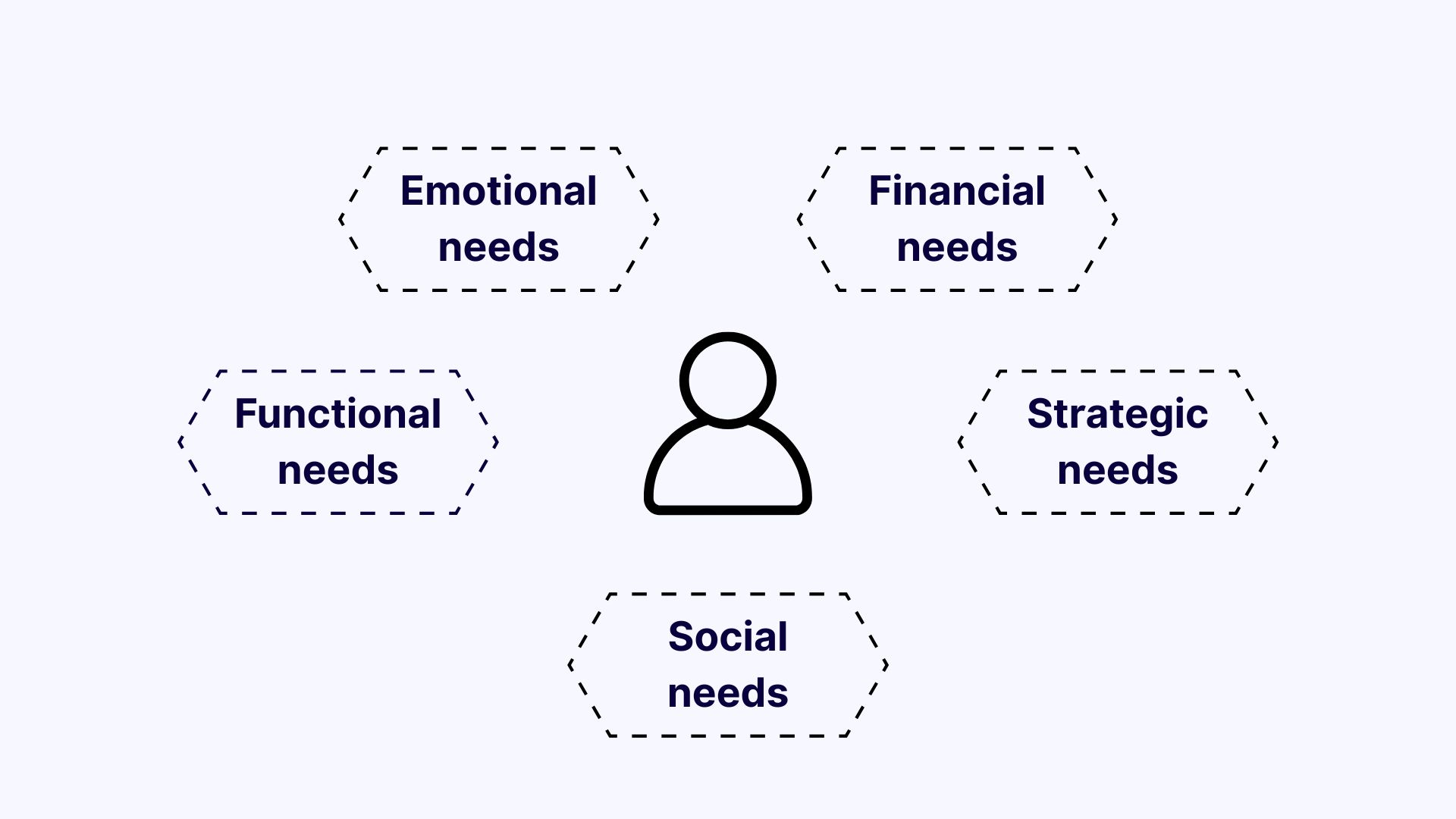
Now that we have covered definitions (and sad facts), let’s discuss the types of needs that clients have in the first place. These fall into 5 types:
- Functional needs: Practical requirements related to what a product or service must do to solve a specific problem.
- Emotional needs: Psychological factors that influence decisions, including desires for confidence, security, status, simplicity, or control.
- Social needs: Concerns about how decisions affect reputation, relationships, and perception among peers, customers, or stakeholders.
- Strategic needs: Long-term business objectives that solutions must support, including scalability for growth, competitive differentiation, or market positioning.
- Financial needs: Budget constraints, ROI requirements, and economic considerations that determine feasibility.
Why Is Client Needs Analysis Critical for Business Growth?
Evaluation of clients’ needs directly impacts revenue by improving win rates, customer retention, and lifetime value. When companies understand requirements before offering their solutions, they create more accurate proposals, reduce sales cycles, and build stronger relationships that lead to repeat business.
Now that you are familiar with the short answer, let’s examine how client needs analysis influences business growth:
- Increased conversion rates: Companies that understand client goals before they offer solutions address actual pain points rather than assumed problems. This helps increase the likelihood of wins and shortens decision timelines.
- Strengthened lead qualification: Thorough needs analysis reveals when a prospect’s expectations, budget, or timeline do not align with what the business can profitably deliver. As a result, businesses can save resources.
- Improved customer retention and lifetime value: A detailed needs evaluation also serves as a foundation for service delivery that adapts to requirements over time, encouraging customer retention.
- Stronger competitive differentiation: Deep assessment of client requirements identifies what customers actually need. This positions businesses as advisors who understand the problem before clients can see it.
- Efficient resource allocation: Proper analysis ensures company resources flow directly into high-value work, and profit margins remain intact as the scope evolves.
To conclude, businesses that understand their target audience can invest more in delivery quality, which improves retention, builds institutional knowledge, and enables better resource & operations planning.
What Are the Methods of Client Needs Analysis?
Client needs analysis relies on multiple data collection methods to build a complete picture of client requirements. The most effective approach combines qualitative methods, such as interviews and focus groups, with quantitative methods, such as surveys and behavioral analysis. Teams in professional services typically use multiple methods simultaneously to validate findings and find insights that single-method approaches may overlook.
Below, you will find customer needs analysis methods, split into 3 categories: direct feedback, observational research, and competitive analysis.
|
Category of Client Needs Analysis Method
|
Examples
|
|---|---|
|
Direct Feedback
|
|
|
Observational Research
|
|
|
Competitive Analysis
|
Feature gaps, roadmap differences, pricing models, industry reports, benchmarks, analyst insights
|
Client Interviews and Discovery Calls
Client interviews are a direct feedback method that helps businesses identify the gap between stated needs and actual needs. These conversations enable consulting professionals to ask follow-up questions, read nonverbal cues, and explore the context. The most valuable insights usually surface when interviewers probe with “why” questions. They showcase underlying business pressures, past failed solutions, and other limitations that can influence decisions.
Tip: Use advanced AI meeting assistants, such as Sembly, to analyze sentiment and understand which topics generate enthusiasm or reluctance.
Focus Groups and Workshops
Focus groups bring multiple clients or stakeholders to discuss needs, priorities, and pain points in a moderated group setting. This dynamic often helps gather insights that individual interviews miss as participants build on each other’s ideas, challenge assumptions, and disagree on priorities. The direct feedback method works well when validation of the design or understanding how different roles within an organization perceive the same problem is required.
Tip: Record focus group sessions with AI transcription software to analyze patterns, identify recurring themes, and track which topics generate the most engagement or disagreement.
Behavioral Data Analysis
Behavioral analysis is an observational research method that examines how clients use products, which features they ignore, and what triggers them to seek support. This method includes website analytics, product usage data, support ticket patterns, and purchase history analysis. The advantage is objectivity: behavioral data shows patterns without the bias of self-reported information. However, this method focuses on what is happening but not why, which makes it most powerful when combined with qualitative methods.
Customer Journey Mapping
Effective journey mapping is another observational method that visualizes every client touchpoint with a business. It identifies pain points, moments of satisfaction, and gaps in the experience that clients might not articulate directly. The most valuable maps also include the “shadow journey”. It includes workarounds, informal processes, and third-party tools that clients use to bridge gaps in the official experience.
Tip: Update journey maps quarterly based on new client feedback and behavioral data. Client needs and expectations change, and outdated journey maps often lead to solutions that address irrelevant problems.
Competitive Analysis and Market Research
Competitive analysis analyzes market baselines and expectations to understand client needs. This method examines the alternatives clients consider, why previous vendor relationships ended, and which competitor capabilities generate consistent interest. The strategic value of this needs assessment lies in understanding how competitors have shaped client expectations.
How Do You Conduct a Client Needs Analysis?
Effective client needs evaluation is a systematic process that moves from preparation through execution to insights. The framework below can be a solid foundation for both individual client engagements and complex projects. I have also added specific actions and validation checkpoints to ensure nothing critical is missed.
Let’s take a closer look at the steps, shall we?
- Define objectives and scope: Establish what information you need and which client segments or accounts to analyze. Identify the specific business decisions this analysis will support.
- Choose research methods: Choose methods that align with your timeline, client access, and information depth requirements. Combine direct feedback with behavioral observation and data from market research tools to validate findings.
- Prepare research instruments and frameworks: Create interview guides, customer questionnaires, and data collection templates before you engage with clients. Strong preparation determines whether you identify preferences or root causes.
- Collect data using chosen methods: Host interviews, send surveys, extract behavioral data, and conduct competitive research.
- Analyze findings: Look for patterns across customer data sources and separate preferences from actual needs. Check where different methods intersect or conflict to validate your conclusions.
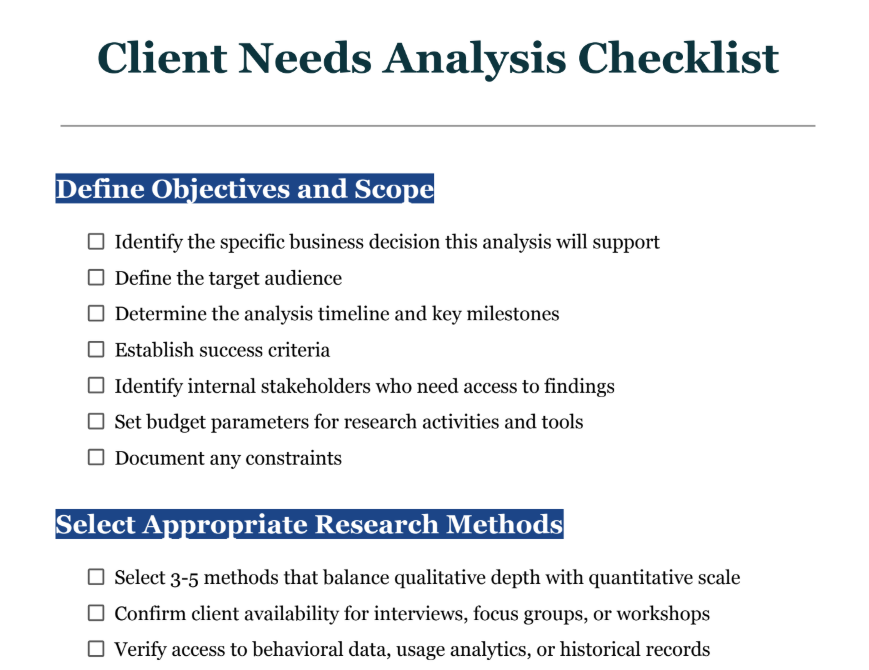
The customer needs analysis checklist includes all 5 previously discussed steps with key checkpoints that will help you conduct a comprehensive evaluation.
What Is the Best AI Tool for Client Needs Analysis?
Sembly is the best AI meeting assistant for client needs analysis. It records, transcribes, and analyzes client conversations in over 45 languages to extract pain points, goals, stakeholder concerns, and decision-making criteria. The platform identifies speaker sentiment, tracks who said what, and generates structured meeting summaries that preserve context. Sembly rebuilds client needs analysis from a time-intensive process into a systematic workflow that captures every detail and surfaces patterns that human analysis might miss.

What Are the Sembly Features to Optimize Client Needs Analysis?
- Sentiment analysis: Detects enthusiasm or concern in client responses to reveal priorities that tone and word choice indicate.
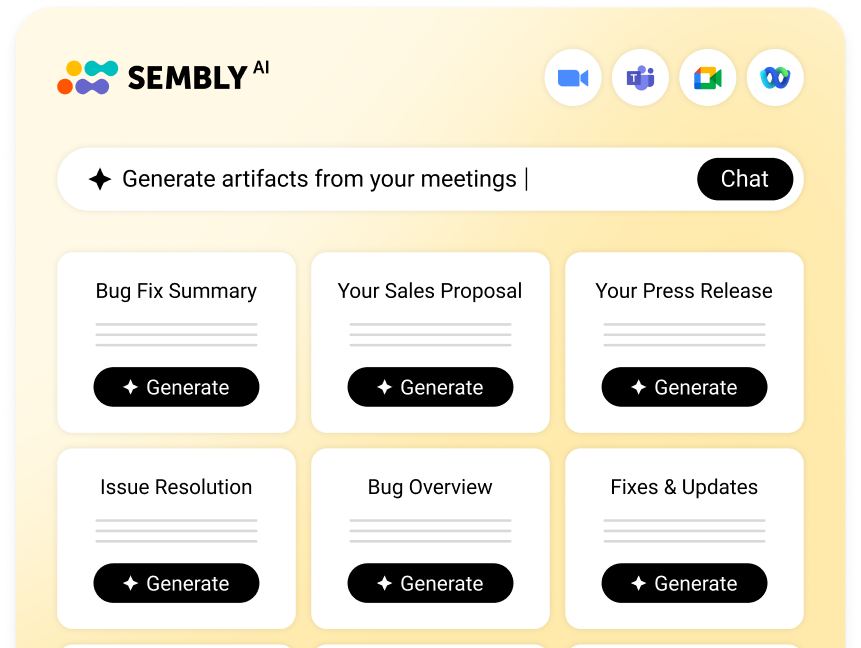
- AI artifacts: Drafts structured and personalized documentation, including customer needs analysis based on the meeting content.
- Automatic transcription with speaker identification: Captures discussions from discovery calls, focus groups, and workshops with accurate attribution to individual speakers.
- Pain point and goal extraction: AI identifies client challenges, outcomes, and success criteria mentioned throughout conversations.
- Multi-meeting intelligence: Analyzes patterns across multiple client interactions to identify recurring themes and changing needs.
How Can You Generate a Client Needs Analysis Report with Sembly?
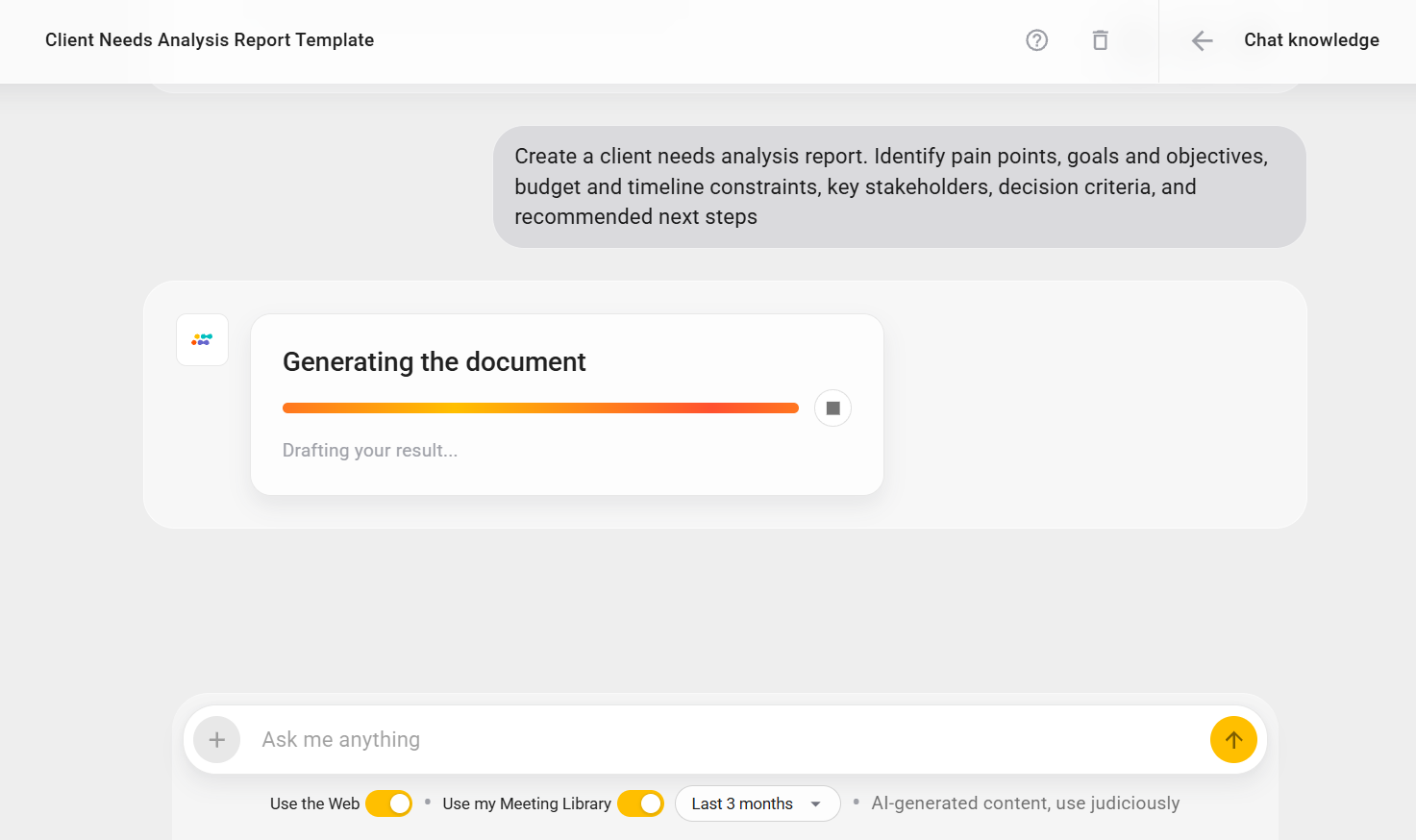
Sembly drafts personalized needs analysis reports through its AI chat interface. After the tool processes a discovery call or workshop, professionals can request comprehensive reports that organize client insights into actionable categories. The process takes minutes and maintains the accuracy that manual summarization cannot match.
- Go to the Semblian section in the side menu.
- Click the “+” icon.
- Attach the meeting to the chat.
- Ask Sembly, “Create a client needs analysis report. Identify pain points, goals and objectives, budget and timeline constraints, key stakeholders, decision criteria, and recommended next steps.”
- Done!
What Are Essential Client Needs Analysis Questions?
The difference between average and comprehensive needs analysis lies in the quality of the questions. Generic or vague questions often produce surface-level answers, whereas strategic questions focus on the gap between what clients think they need and what will solve their problem. Below, you will find ideas for questions to uncover motivations, organizational dynamics, and constraints that influence decisions.
Company Background and Context Questions
- When you brought this to leadership, what was their first concern?
- What systems or processes would need to change along with this solution?
- What triggered your decision to address this problem now rather than six months ago?
- What department is most affected by this problem? How does it affect their efficiency?
- What have you tried already to solve this? Why did it not work?
- What will be the negative changes if this issue remains for another quarter?
Pain Point and Challenge Questions
- What workarounds has your team built? How much time do they spend on those each week?
- What data would you like to gather about this problem but don’t currently capture?
- Which aspect of this problem frustrates your team the most?
- When does this problem cause the biggest disruption to your business?
Goals and Success Criteria Questions
- What unofficial metric will your team use to judge whether this works?
- What does success look like three months after implementation?
- How will you measure whether this investment was worthwhile?
- If this succeeds, what problem does that create for other parts of the organization?
Decision-Making Process Questions
- Who needs to approve this before you can move forward?
- What information do decision-makers need to see before they commit?
- Who has the authority to expand or reduce the scope of this project?
- What percentage of projects that reach this stage actually get implemented?
Budget and Timeline Questions
- What budget has been allocated for this? Is that fixed or flexible?
- How does the approval authority change at different price points?
- What deadline are you working toward, and what drives that timeline?
- How was the budget for this project determined?
- What other projects are competing for the same budget or resources?
The power of these questions is not in asking all of them, but in selecting the ones that expose the dynamics your engagement needs to understand. For example, early-stage discovery focuses on context and pain points. Mid-stage conversations usually concentrate on goals and the decision-making process. Final-stage, on the other hand, addresses budget and competitive positioning to close deals.
Wrapping Up
A comprehensive client needs analysis closes the gap between expectations and delivery through a systematic understanding of what customers require before they articulate it. The key? Combine multiple research methods, ask questions that reveal organizational dynamics, and use AI to capture insights. This will help your team win better deals with clients whose needs they can meet, which compounds into stronger retention, higher profitability, and referrals that arrive pre-qualified.
In this article, we have defined customer needs assessment, explored its types, benefits, and steps. We have also reviewed common research methods, questions, and tested the best AI for professional teams. I hope you have enjoyed this edition. Good luck!
FAQ
What is the definition of the customer needs analysis?
Customer needs analysis or client needs analysis is a systematic research process that identifies what customers require from a product, service, or business relationship before solutions are proposed. It combines qualitative methods with quantitative approaches to identify functional requirements, emotional drivers, decision criteria, and organizational constraints.
How do you conduct a customer needs analysis for enterprise clients vs. small businesses?
Enterprise needs analysis requires interviewing stakeholders across multiple departments because purchasing decisions involve several people with different priorities. Small business analysis focuses on fewer decision-makers who typically control both budget and implementation.
Enterprise analysis usually demands 6-12 stakeholder interviews across departments, while small business analysis typically requires 2-3 conversations with decision-makers.
Here are the peculiarities of small business needs analysis:
- Conduct 2-3 conversations with owner and key decision-makers
- Focus on immediate pain points and cash flow impact
- Assess implementation bandwidth with limited staff
- Expect faster decisions (days to weeks)
- Highlight quick wins and minimal disruption
Here are the peculiarities of enterprise client analysis:
- Interview 6-12 stakeholders across departments (IT, finance, operations, end users)
- Map decision-making authority and approval processes
- Address stakeholder alignment and change management
- Account for longer sales cycles (3-12 months)
- Focus on scalability and cross-departmental impact
What are the most common needs analysis mistakes?
Most needs analysis failures happen when methods do not match the complexity of what clients actually need.
Here are the commonly inefficient approaches to client needs evaluation:
- Isolated surveys: Present fixed answer choices that force clients to select from predefined options.
- Single interviews: Capture only what clients feel comfortable sharing in initial conversations.
- Behavioral data alone: Tracks clicks, usage patterns, and feature adoption without explaining motivation.
- Feature comparison competitive analysis: Creates spreadsheets comparing capabilities across vendors without understanding decision drivers.
- One-time assessments: Treat needs as static when they shift constantly with business growth, market changes, and leadership transitions.
How do you conduct ongoing needs analysis for existing clients?
Existing client analysis focuses on how needs evolve rather than initial discovery. Here are ongoing needs analysis methods:
- Quarterly business reviews: Ask the client what recently has changed in their business.
- Behavioral monitoring: Track usage pattern shifts, including increased support tickets, feature adoption changes, workflow modifications.
- Proactive outreach: Identify needs before clients request them based on growth indicators or approaching system limits.
- Stakeholder expansion: Map which departments aren’t yet using solutions but face problems they could solve
What are the benefits of ongoing client needs analysis?
Here are the key benefits of ongoing client analysis:
- Early identification of expansion opportunities: Identify growing needs before clients start considering other vendors.
- Reduced churn: Regular analysis surfaces dissatisfaction early enough to address root causes. during renewal conversations.
- Faster adaptation to market changes: Ongoing analysis keeps solutions aligned with current reality rather than outdated initial requirements.
- Stronger institutional knowledge: Each analysis builds understanding of how client needs evolve across business cycles, growth stages, and organizational changes.
- Higher account profitability: Proactive needs analysis prevents scope creep and reduces support costs by identifying training gaps and workflow issues.
- Multi-meeting chats
- AI Insights
- AI Artifacts

You might also like
