

Table of Contents
ToggleDid you know that 60% of companies reported an increase in their time-to-hire (GoodTime)? Now, add poor communication with candidates as one of the top 3 bottlenecks in the hiring process, and there you have it: a major problem. In consulting, where a bad hire results in revenue loss, a structured feedback system is often the only thing that separates companies that work with top talent from the rest. When there are no clear assessment criteria, every potential hire becomes a negotiation between partners with different evaluation styles, priorities, and definitions of a strong candidate.
In this article, we will review 40+ interview feedback examples to improve alignment and ensure the next newcomer strengthens the business. You will also explore the types of feedback and their importance, and try the AI tool that can help you base recruiting decisions on data. Enough talking, let’s get started!
Why Does Interview Feedback Matter in Hiring?
Interview feedback directly impacts your ability to hire the best professionals out of the candidate pool and maintain a positive brand image. It serves as a documentation trail for legal compliance or can even be a competitive advantage in markets where top talent has multiple offers. Yet the current state of candidate communication reveals a massive gap between what talent expects and what most businesses provide.
Let’s take a look at what the recruitment process is for both a candidate and a company:
- Around 60% of professionals mention having a negative candidate experience (CareerArc).
- Candidates are 4 times more likely to consider the company in the future if they receive constructive feedback during their interview process (Lever).
- 65% of specialists rarely or never receive any notice about their applications (CareerArc).
- More than 70% of candidates shared their negative interview experience on social media. However, 28% of companies never check it (CareerArc).
- Over 60% of professionals check company reviews before applying to a job post (Lever).
For professional services, these numbers translate to business impact. Every negative candidate experience is a potential review that prospects read, and every ignored candidate is a lost referral opportunity in an industry built on relationships. The cost of poor feedback is revenue, employer brand, and competitive positioning, and thus, it is important to provide it.
How Do You Provide Candidates with Quality Interview Feedback?
Effective candidate feedback after an interview requires three elements: honesty, specificity, and speed. The key is to balance each with professionalism, thoughtfulness, and enough detail to make feedback comprehensive. However, many hiring teams either share unfiltered internal assessments that damage relationships with candidates or send generic rejection templates with little value.
I suggest that we review approaches to post-interview feedback based on the stage the candidates go through.
Initial Screening
Candidates at this stage usually expect acknowledgment and clarity rather than detailed analysis. Reference their actual background specifically, mention what they do have, and explain the specific gap relative to job requirements, if any. Focus on the required certifications, experience levels, or technical skills the candidate lacks, and point them toward opportunities where their background is stronger.
Tip: Create 5-7 templated rejection reasons linked to the most common disqualifiers. Personalize the opening and closing sentences and add context where possible.
Technical Task or Assessments
Mention the candidate’s test results and explain how you evaluated them. Gather comments from the hiring manager to highlight the strong sides of the technical task, as well as its weaknesses. Include learning resources, such as specific courses, books, or practice platforms relevant to the problems you identified. This stage often determines whether candidates recommend your company or leave negative reviews about wasted effort, so it is important to provide feedback that people can work with.
Interview with a Hiring Manager
Reference specific moments from your conversation to prove you paid attention and make your assessment credible. Start your job interview feedback by highlighting strengths: describe a candidate’s success or the insightful questions they asked about the company’s hybrid culture. Mention any gaps relative to this specific role and explain why they are not a good match for this job posting. Help talent understand what would make them stronger for similar roles.
Team Interview
Treat finalist interview feedback as a business relationship conversation. Explain the comparative decision-making process transparently and mention any distinguishing features the hiring manager paid attention to. Offer to make introductions to your network, suggest specific companies hiring for similar roles, or provide an insider perspective on how they should position themselves in interviews. This can help strengthen the employer’s credibility and build a positive company image.
Tip: Tag finalists in your ATS platforms and proactively contact these candidates when similar opportunities appear (before publishing them publicly).
What Are the Main Types of Interview Feedback?
Interview feedback usually falls into 6 distinct categories, each serving a specific goal in the hiring process and candidate relationship. When professionals understand these types and their nuances, they can select the best-fitting approach for different situations and stakeholders.
Let’s take a closer look at the main types of interview feedback:
|
Type of Feedback
|
Goal
|
Example
|
|---|---|---|
|
Positive Feedback
|
Highlights the candidate’s strengths and builds confidence
|
“Your sales presentation clearly connected product features to client business outcomes, which highlighted your strong consultative skills.”
|
|
Constructive Feedback
|
Guides improvement with actionable steps
|
|
|
Behavioral Feedback
|
Grounds assessment in observable actions using the STAR method
|
|
|
Competency-Based Feedback
|
Maps candidate abilities to job requirements
|
“Project management methodology knowledge exceeds expectations. However, risk matrix creation needs development for senior PM roles.”
|
|
Feedback on Culture Fit
|
Assesses alignment with values and work style
|
|
|
Feedback on Technical Skills
|
Evaluates specific tools and technical knowledge
|
“Your CRM management and pipeline forecasting are strong. However, experience automating sales workflows would strengthen your profile for this sales ops role.”
|
40+ Interview Feedback Examples
Now that the theory is settled, I suggest that we answer the main question: What are the effective examples of interview feedback comments? In this section, we will review over 40 samples with variables to help you customize each to your needs and candidates. Let’s get started, shall we?
Positive Interview Feedback Examples
Below, you will find 20 examples of positive feedback for candidates after their interviews based on the skill.
Positive Interview Feedback on Technical Expertise
- “You connected [Team Dependencies] to a concrete [Risk Details] and explained how you’d track and mitigate it. Your risk matrix example also showed the level of reporting skills we expect from a [Role Name].”
- “Your proficiency with [Tool Name] exceeded our expectations for [Role Level].”
- “During the [Technical Exercise], you identified [Issue Name] and proposed [Solution Name] that addressed both [Key Point 1] and [Key Point 2].”
- “Your [Activity] demonstrated strong attention to detail, which is mandatory for [Role Name] in our company.”
- “The way you approached [Task Name] showed mastery of [Skill Name] that we rarely see at [Experience Level].”
Positive Interview Feedback on Problem-Solving
- “You broke down [Problem Name] into [Components], demonstrating strong strategic thinking skills.”
- “The [Team Name] loved how you questioned your own assumptions during [Exercise], especially when [Specific Moment] wouldn’t work.”
- “Your [Specific Technique] is exactly how our [Senior Consultants] approach these challenges.”
- “We were impressed by how you handled our pushback and revised your thinking when you received new information. The logic you used to get from [Problem Name] to [Solution] was airtight.”
- “You quickly adjusted your pace when [Team Member Name] asked questions and professionally tied everything back to [Outcome Details].”
Positive Interview Feedback on Communication Skills
- “You read the room well. When [Team Member Name] looked confused about [Concept], you immediately adjusted your approach by [Specific Action].”
- “You acknowledged the client’s [Perspective Details], explained your [Reasoning], and found common ground without being defensive. This [Approach Name] is exactly what [Role Name] requires.”
- “We could tell you’ve presented to [Audience Name] before based on how you structured your responses. This executive communication maturity is ahead of your [Role Level].”
Positive Interview Feedback on Culture Fit
- “The way you described your ideal work environment matches the way we operate daily. When you mentioned [Problem Name], you identified the exact inefficiency our culture was designed to solve.”
- “The questions you asked about [Cultural Element] showed you’ve really thought this through. Additionally, your questions about [Particular Aspect] highlighted that you’ve worked in [Work Environment Type] before.”
- “During [Exercise Type], you chose to [Behavior] instead of [Alternative Behavior], which is exactly how we think about [Cultural Principle].”
- “When talking about [Scenario A] and [Scenario B], you naturally showed [Behavior]. This consistency confirms it’s the way you approach [Case Details], which aligns with our culture.”
Positive Interview Feedback on Collaboration Skills
- “When we asked about [Disagreement Scenario], your response focused on understanding why [Stakeholder] wanted [Approach Name] before pushing your alternative. You described [Specific Action] rather than advocating harder for your position.”
- “Your question during [Team Discussion] changed the direction entirely. You identified the [Risk] that others missed, voiced it respectfully, and the group corrected their course.”
- “Your approach to [Group Task] balanced assertiveness with receptivity really well. This intellectual flexibility in real-time collaboration is what makes [Team Dynamics] productive.”
Negative Interview Feedback Examples
Now that the positive candidate interview feedback is covered, I suggest that we move to the less engaging part and review comments on negative results. I have prepared another list of 20+ samples with variables that can give you an idea of the information candidates may need.
Negative Interview Feedback on Technical Expertise
- “You missed [Technical Detail] during [Task Name] that would have caused [Specific Problem] in production. Specifically, when you built [Deliverable], you didn’t account for [Case Details]. For [Role Name], this is a core requirement.”
- “Your [Skill Name] is at [Level], but this position requires [Level]. We believe that building experience with [Specific Area] would make you more competitive.”
- “Your technical explanation during [Discussion Topic] used correct terminology but revealed conceptual gaps. When we asked [Question] about [Issue Name], your answer showed [Actual Response] rather than [Expected Response].”
- “During [Discussion], you recommended [Technology] for [Scenario], where [Alternative] would be more appropriate.”
Negative Interview Feedback on Problem-Solving
- “When [Problem Name] had multiple possible causes, you seemed focused only on [Hypothesis] and built your entire solution around it. However, you didn’t explore [Alternative Explanation] that could equally explain [Outcome].”
- “Your solution to [Challenge] was [Negative Result] for what we actually needed. You proposed [Solution Details] when [ Alternative Approach] would have delivered [Outcome] in [Time/Cost].”
- “During [Case Study], you started with [Approach A], switched to [Approach B], then mentioned [Approach C]. However, you did not explain why you abandoned the others.”
- “You described [Problem] accurately, but your solution addressed [Point 1] and [Point 2] rather than [Expected Result].”
Negative Interview Feedback on Communication Skills
- In [Discussion], you didn’t adjust pace or clarify [Topic] when we looked confused or asked follow-ups. A quick check-in would have helped you keep the room.
- “When we challenged your [Idea Name] during [Discussion], your tone shifted from collaborative to [Negative Pattern]. You began justifying your point [Negative Behavior], making it hard to explore alternatives.”
- “You spoke over [Team Member] twice during [Exercise Name] without noticing they were trying to contribute.”
- “In [Scenario], you didn’t separate facts from assumptions. Unfortunately, it made it hard to understand what you knew vs. what you were inferring about [Problem details].”
- “Your explanation of [Topic] had detail, but no clear headline. When you finished, we were still unsure of your final position on [Decision] and what you’d do first.”
Negative Interview Feedback on Culture Fit
- “You described a strong preference for [Process] and seemed reluctant to adapt when we shared how our workflow changes across projects. In our culture, [Quality] matters more than [Quality].”
- “When we offered feedback on [Approach], you acknowledged it but didn’t integrate it into the next steps. In our culture, we look for [Role Name] who can adjust.”
- “When we asked about a past setback in [Project Workstream], your answers avoided specifics. We value candor around mistakes and learning.”
- “In [Exercise], you focused on [Aspect 1] rather than [Aspect 2]. We rely on collaborative problem-solving, especially in cross-functional settings.”
Negative Interview Feedback on Collaboration Skills
- “When [Teammate Name] suggested [Idea], you used it in your solution but didn’t acknowledge [Key Point]. It may appear small, but it negatively influences trust and how people at [Company Name] collaborate.”
- “You kept the same communication style even when [Partner] needed a different level of detail. Strong collaborators adjust and add a summary for [Audience].”
- “When we role-played with [Team Member name], you didn’t reflect their concerns. It is important that a professional on [Role Name] understands priorities before pushing decisions through.”
- “During [Session Name], you shared solid ideas, but you didn’t structure the conversation. There was no clear meeting agenda, timeboxing, or closing with owners.”
- “Your message wasn’t structured for [Target Audience], so [Team Member Name] had to interpret what mattered. Collaborative communication should be [Quality 1], [Quality 2], and [Quality 3].”
How Can AI Help Automate Interview Feedback?
Let’s talk about cognitive overload during interviews. Professional recruiters often listen to a candidate explain their achievements while simultaneously trying to capture their approach, consider cultural fit, and plan their next question. As a result, specifics often go unnoticed, and at the end of the day, there is no evidence to support hiring decisions. Recruiters cannot provide rejected candidates with constructive feedback, which damages your employer brand and job search experience. Additionally, the talent pipeline loses its value as vague notes fail to showcase each candidate’s strengths. Fortunately, it is nothing an advanced meeting assistant, such as Sembly, cannot fix.
Trusted by over 2,000 professional teams, Sembly captures and analyzes conversations to help recruiters identify and communicate with top talent. It can evaluate each candidate against the company’s culture and job requirements, as well as help recruiters find specific cases from the interview to strengthen their feedback.
Here are the best prompts you can use:
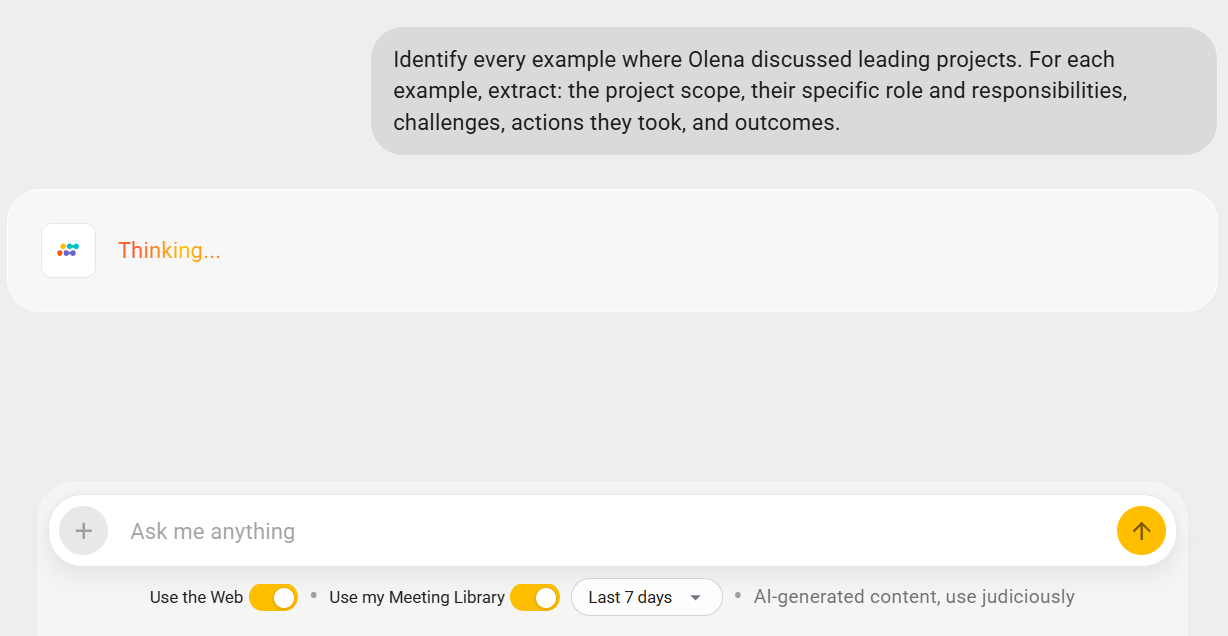
- “Identify every example where [Candidate Name] discussed leading projects. For each example, extract: the project scope, their specific role and responsibilities, challenges, actions they took, and outcomes.”
- “Analyze [Candidate Name] responses for evidence of [Company Values]. Provide specific quotes where they demonstrated [Quality 1], [Quality 2], and [Quality 3]. Also note any examples where they deflected [Point 1] pr [Point 2].”
- “Compare how [Candidate A], [Candidate B], and [Candidate C] each answered the question about [Topic]. Summarize each person’s approach, identify key differences, and note which response demonstrated the most [Quality].”
3 Common Interview Feedback Mistakes
Even experienced recruiting specialists can make mistakes that damage relationships with candidates and negatively impact the brand’s image. These are not always obvious situations when feedback is generic and carries no value. Sometimes, the problem lies in poor timing or tone, and in this section, we will explore exactly that: overlooked mistakes when providing feedback on interviews.
Waiting Too Long to Send Interview Feedback
Poorly timed candidate feedback often leads to inaccurate assessments and unbalanced experiences with the brand. When recruiters write comments weeks after the conversation, they base them on brief notes and memory rather than actual observations. Specific examples become hard to find, nuanced impressions fade, and generic phrases replace concrete evidence.
Tip: Use transcription software, such as Sembly, to search for behavioral aspects, extract specific quotes from the candidate’s responses, and create personalized follow-ups or interview summaries.
Providing Overly Positive Feedback to Rejected Candidates
Overly positive rejection feedback often misleads candidates and prevents professional growth. A candidate who lacks the required enterprise experience may interpret interview results as minor fit issues rather than fundamental skill deficits. This false encouragement prioritizes recruiter comfort over candidate growth, avoiding honest conversations about what specifically fell short.
Tip: State one concrete gap with evidence. For example, “The customer acquisition examples shared involved $5K-$20K deals. This enterprise role handles $500K+ contracts requiring different stakeholder management and longer sales cycles.”
Reusing the Same Interview Feedback Templates
When recruiting professionals fill in feedback forms with generic comments, candidates receive identical language across multiple companies and rejections. As a result, the feedback lacks specific observations from their actual interview. It can damage future relationships with talent who might have been strong fits for upcoming company roles.
Wrapping Up
Interview feedback often determines whether rejected candidates become advocates of the company or its critics, so it is important to dedicate time and effort to providing talent with quality responses. The difference between companies that hire well and companies that hire comes down to systems: documented evaluation standards, assigned accountability, evidence-based assessments, and feedback delivered promptly.
In this articlem we have examined the role of candidate feedback, studied its types, and reviewed 40+ examples of comments recruiters can use. We have also discussed how AI can optimize the process and increase the quality of responses. I hope you have enjoyed this guide. Good luck hiring!
FAQ
Why is post-interview feedback important?
Post-interview feedback protects hiring decisions from legal challenges, improves candidate experience, and creates reusable talent pipeline data for future openings.
How do you provide candidate feedback after an interview?
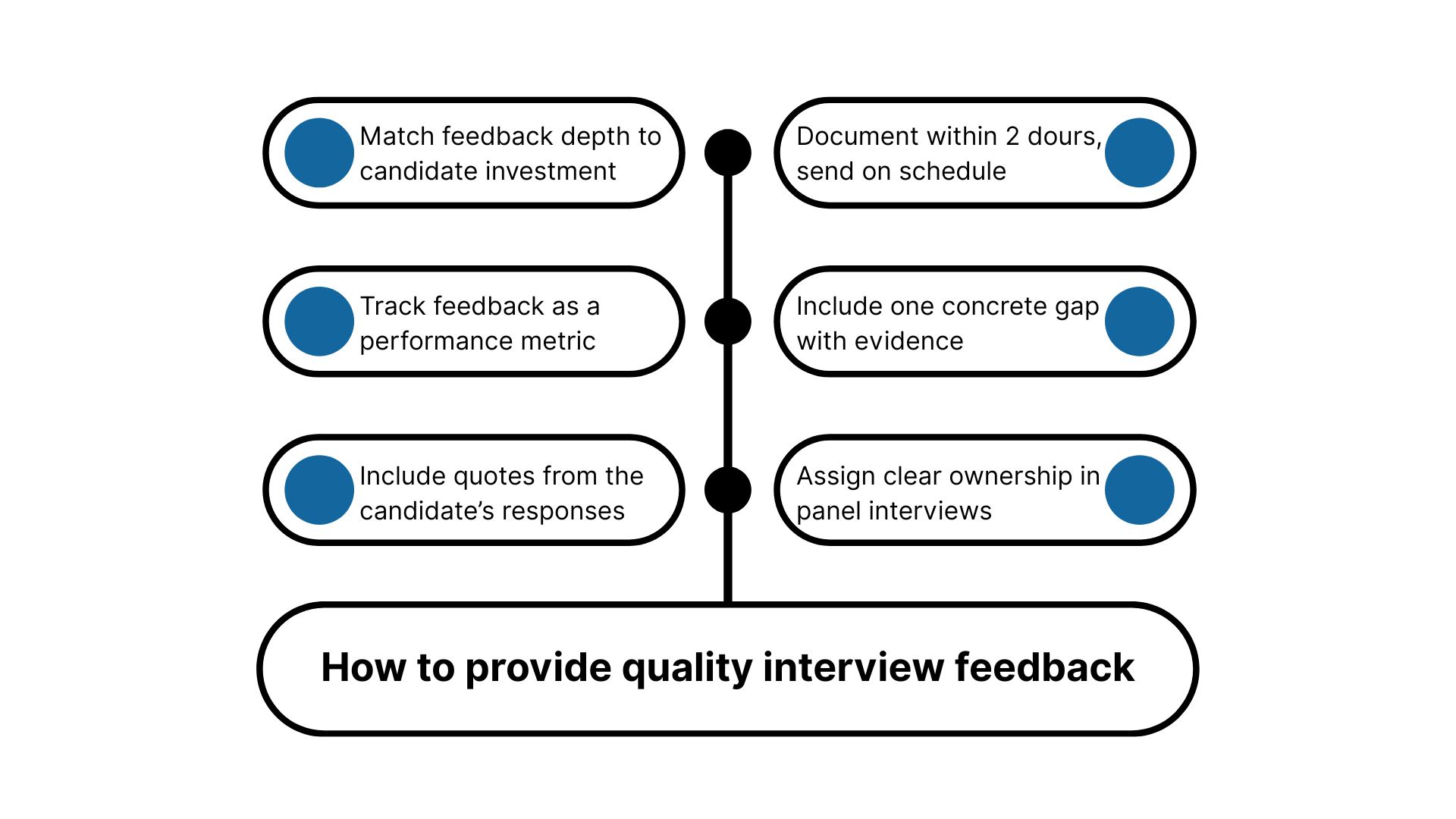
- Match feedback depth to how far candidates progressed.
- Document details within two hours while memory retains specifics. Include one concrete gap with interview evidence.
- Use candidate’s actual words or paraphrases from their responses to prove genuine engagement.
- Assign one person as feedback owner in panel interviews to ensure someone sends consolidated assessment within 48 hours.
How do you provide negative feedback after an interview?
State the specific gap between what the role requires and what the candidate demonstrated, using evidence from the interview rather than subjective judgments. Reference exact interview moments or timestamps when possible and avoid cushioning honest feedback with excessive positivity.
What are the professional interview feedback best practices?
- Capture detailed observations within two hours of interviews, then scheduling when feedback sends regardless of pipeline status.
- Include at least one direct quote or specific paraphrase from candidate responses in every feedback to prove engagement with their actual conversation. Assign explicit feedback ownership before panel interviews.
- Track feedback completion rates by interviewer in weekly recruiting reviews to create accountability and identify bottlenecks.
- Review all external feedback for legal compliance, ensuring comments focus on observable skills and job requirements.
- Specify exactly what additional experience or skills would make them competitive for similar future roles.
What is the best platform for AI interview feedback?
Sembly is the best platform for AI interview feedback. It captures and transcribes conversations in 45+ languages, identifies different sentiments, and can evaluate candidates against company’s requirements or culture. Sembly also drafts documents and creates personalized follow-ups based on the available meeting content, making it a great addition to any recruiting team.
- Multi-meeting chats
- AI Insights
- AI Artifacts

You might also like
