

Table of Contents
ToggleIt’s the end of the quarter. You send a comprehensive presentation to a client, filled with employee metrics, product usage trends, and data tables. However, all you get in response is silence. There are no follow‑ups, no questions, and the renewal conversation six months later is quite cold. The relationship feels rather transactional and replaceable, and your chances of retaining this customer are declining as time passes. The reason is often more obvious than it appears at first sight: some professionals treat quarterly business reviews as a chore. They are eager to tick all the boxes and move on to the next project. As a result, clients do not see the value the product brings.
In this article, we will examine the definition of the quarterly business review, inspect key components and tools, study the agenda, as well as explore effective templates. While it may seem like a lot to remember, we will walk you through each step slowly but confidently. Let’s get started!
What Is a Quarterly Business Review?
A quarterly business review, or QBR, is a strategic meeting held every three months to assess performance, align on goals, and plan the next steps. It’s a structured way to ask: What has the company achieved? What needs fixing? What’s the plan for the upcoming quarter? Unlike routine team meetings, QBRs focus on strategy and long-term business value.
There are two types of quarterly business review:
|
Type
|
Audience
|
Reason
|
Use Cases
|
|---|---|---|---|
|
Internal quarterly business review
|
Internal company departments and teams
|
Review OKRs, identify blockers, and adjust priorities
|
Sales, marketing, success, product, and operations teams
|
|
External quarterly business review
|
Clients, customers, and business partners
|
Strengthen customer relationships, address concerns, and plan future growth
|
SaaS, agencies, professional services, enterprise accounts
|
The difference between external and internal QBRs lies in their goals. External reviews focus on showcasing the value to the client. They often include performance dashboards, customer health scores, satisfaction trends, and personalized recommendations. Internal QBRs, on the other hand, concentrate on collaboration and ways to improve execution.
In this article, we will provide details you can use as a foundation for both types, so you can choose what fits your needs.
What Are the Key Components of a Quarterly Business Review?
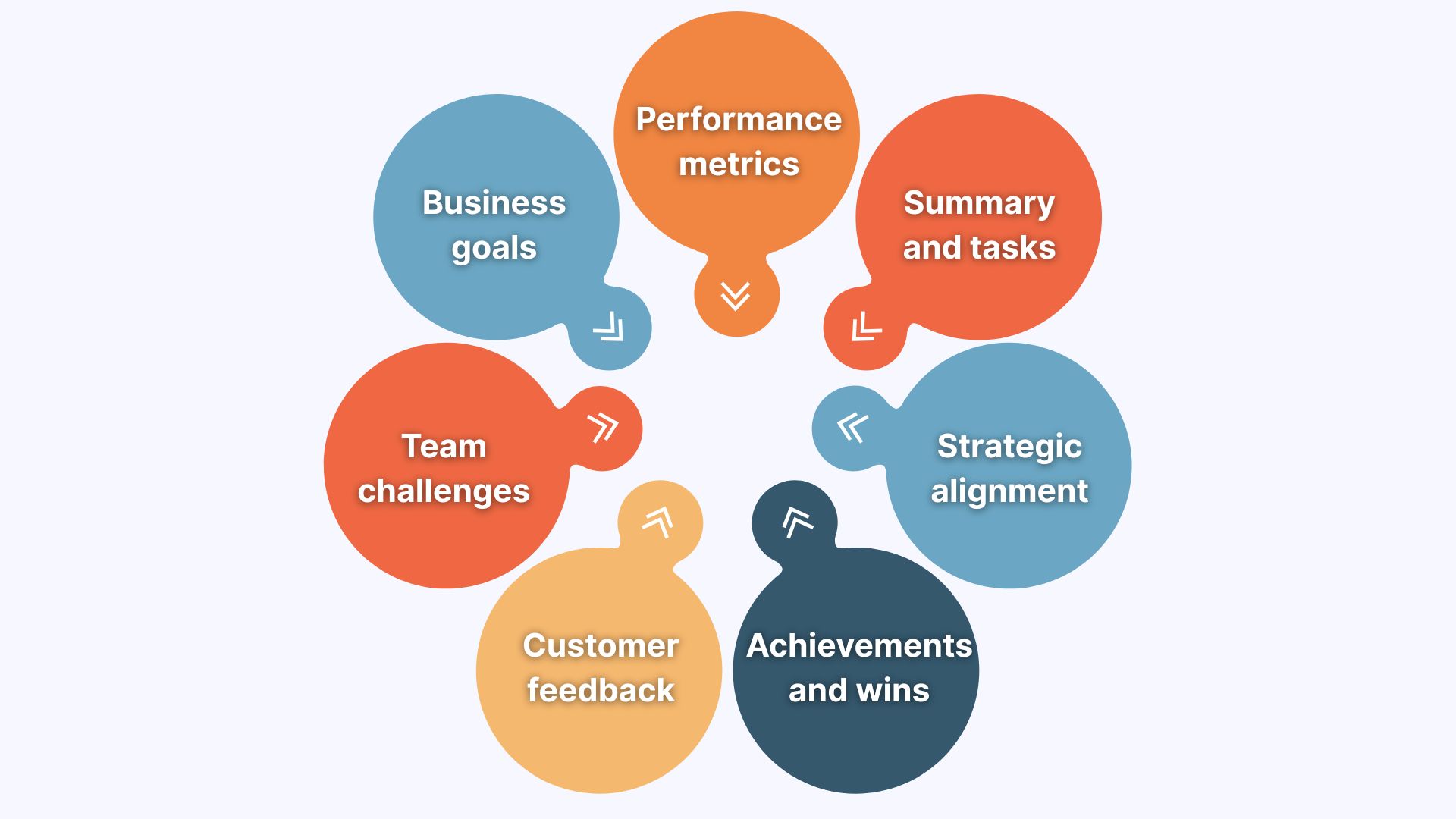
Similar to any other strategic meeting, a strong QBR requires a structure and valuable inputs, regardless of the type. These components ensure that professionals cover important points, stick to the meeting goal, and make key decisions. There are 6 elements you need to consider when preparing for the next QBR:
- Business goals: Remind attendees of strategic targets set in the last quarter. Align the ongoing conversation with the previously approved outcomes to make it relevant.
- Performance metrics: Focus on metrics that are linked to impact. For example, adoption rates, usage frequency, support resolution time, renewal probability, and NPS trends. Use visual dashboards to showcase the results.
- Achievements and challenges: Highlight what worked and explain the reasons. Analyze and discuss the obstacles and challenges. Ask yourself: What’s blocking progress? Is it a lack of workstreams or a resource gap?
- Customer feedback: Use direct quotes or satisfaction ratings from customer success touchpoints, support tickets, surveys, or feedback loops.
- Strategic alignment: Present a 90-day action plan. Introduce new success metrics and suggest the next steps, such as product trainings, feature releases, or process changes.
- Summary and tasks: End quarterly business review meeting with a recap of decisions, next steps, and owners. You can use Sembly to automate conversation analysis.
What Is the Importance of a Quarterly Business Review?
If you are new to the process, you may wonder: Why are QBRs important in the first place? As it appears, companies that have an effective business plan are 30% more likely to grow compared to those that do not have one (ANSI). A comprehensive QBR can help managers assess their strategy and performance and align employees with the organization-wide goals.
I suggest that we examine the main benefits of conducting quality reviews in this section. Below, you will find the main reasons why these assessments matter:
- Churn prevention: During QBR meetings, professionals often review adoption rates, satisfaction scores, and negative churn signals that help identify and address churn early.
- Team alignment: Quarterly business reviews create a regular space for employees to realign. It can mean adjusting onboarding templates, success metrics, or expectations.
- Identifying new opportunities: An effective QBR helps identify new ways to solve problems, areas where more support is needed, or growth opportunities for clients.
- Improved accountability: Quarterly business review meetings help keep teams focused by regularly discussing goals, metrics, and next steps.
How to Prepare for a Quarterly Business Review?
There are 7 key steps to prepare for the quarterly business review meeting. They include identifying the audience and objectives, gathering relevant data, building a structured agenda, personalizing your speech with client context, preparing the “What-If” scenarios, and lastly, discussing the next steps.
Below, you will find these steps explained in detail with examples and recommendations to make the evaluation more effective.
1. Identify the Right Stakeholders
The first step is to clarify the important QBR meeting attendees and decision-makers. For external reviews, these can be executive sponsors, project managers, and influential users. Internally, you can loop in heads of sales, product, marketing, or customer success leaders. Once the list is complete, try to interview them if that’s possible. You can create a pre-QBR form with 3 questions: priorities, concerns, and metrics they are interested in.
2. Define a Specific Quarterly Business Review Objective
The next step is to define the objective early and build the meeting content around it. Why? Ideally, each quarterly business review should serve a strategic purpose. It could be retention, risk mitigation, expansion, or course correction, for example. This way, you understand what data you need and what information should be highlighted.
Template: Maximize [QBR Objective] from [Product Name] by improving [Key Point 1], reducing [Key Point 2], and identifying [Key Point 3].
3. Audit the Available and Relevant Data
Extract your data 5-7 days before the quarterly business review meeting and cross-reference all sources. Identify discrepancies that may appear during FAQ sessions and prepare precise explanations for each. Run calculations manually for the most critical metrics to ensure AI reporting tools have not missed any errors or anomalies.
Tip: Create a “data evaluation checklist” that includes: last login date, feature adoption vs. contracted seats, or support ticket resolution time vs. SLA. Flag any declining metric and prepare an explanation for every number that moved more than 15% in either direction.
4. Build a Strategic Meeting Agenda
Structure your quarterly business review meeting agenda into 5 or 6 time-blocked sections with a defined flow. The first section can focus on the past results and reasons, the second one can concentrate on the present, while the last one discusses the future. Consider assigning an owner and a time limit to each section to keep the meeting focused.
Here is an example of how the QBR meeting agenda can look:
- Review of strategic goals (5 minutes)
- Summary of business impact (10 minutes)
- Risks and challenges review (10 minutes)
- Highlights of customer feedback (5 minutes)
- Plan and expansion opportunities (10 minutes)
- Executive takeaways and next steps (5 minutes)
5. Personalize Your Speech with Client Context
The next step is to try to review the last 90 days from the customer’s perspective and extract exact quotes from support tickets or meeting transcripts. Build a timeline of key moments, such as escalations, wins, or concerns, that shaped their experience with your product. It is best to use your client’s language, objectives, internal goals, and their quotes to increase the credibility of each slide.
Framework: Create a document with the Event, Client Reaction, and Response columns. You can use this structure to make your quarterly business review practical and tied to real examples and cases.
6. Prepare the “What If” Scenarios to Address Risks Proactively
Build projections for three scenarios for maintaining the current state, reducing scope, and expanding usage. To make predictions more practical, consider adding numbers, such as cost impact, efficiency improvements, and risk exposure, and explain your calculation methodology. The key is to approach risks proactively to increase client retention rates.
Tip: Add a visualization of a risk matrix with a 2×2 or 3×3 grid. Place each issue in the quadrant it belongs. Then provide a response plan for each, including an assigned owner, a fix, and a due date.
7. End with a 90-Day Plan with Owners and Metrics
The last step is to create a presentation or a document that connects future activity to a specific company goal and defines measurable outcomes. You can treat it like a mini sales plan, showing how each initiative can help advance. Why? An effective quarterly business review should end with clearly outlined next steps. This way, all involved parties understand what’s expected of them and how to measure their performance.
Can You Automate Quarterly Business Review Reports?
How many hours do you spend reviewing meeting notes, threads, and dashboards to create a QBR report? Probably, a few. However, even with the best approach, key insights still get lost, and the final report ends up missing important information. That’s when Sembly AI can help. It analyzes client check-ins, implementation updates, support escalations, and internal syncs to generate a structured QBR draft. The best about it? It only takes a few minutes.
In addition to advanced AI features, Sembly automatically extracts tasks, key items that include risks, issues, notable events, and achievements, and creates meeting notes and summaries, ensuring professionals have all the required information for an effective quarterly business review.
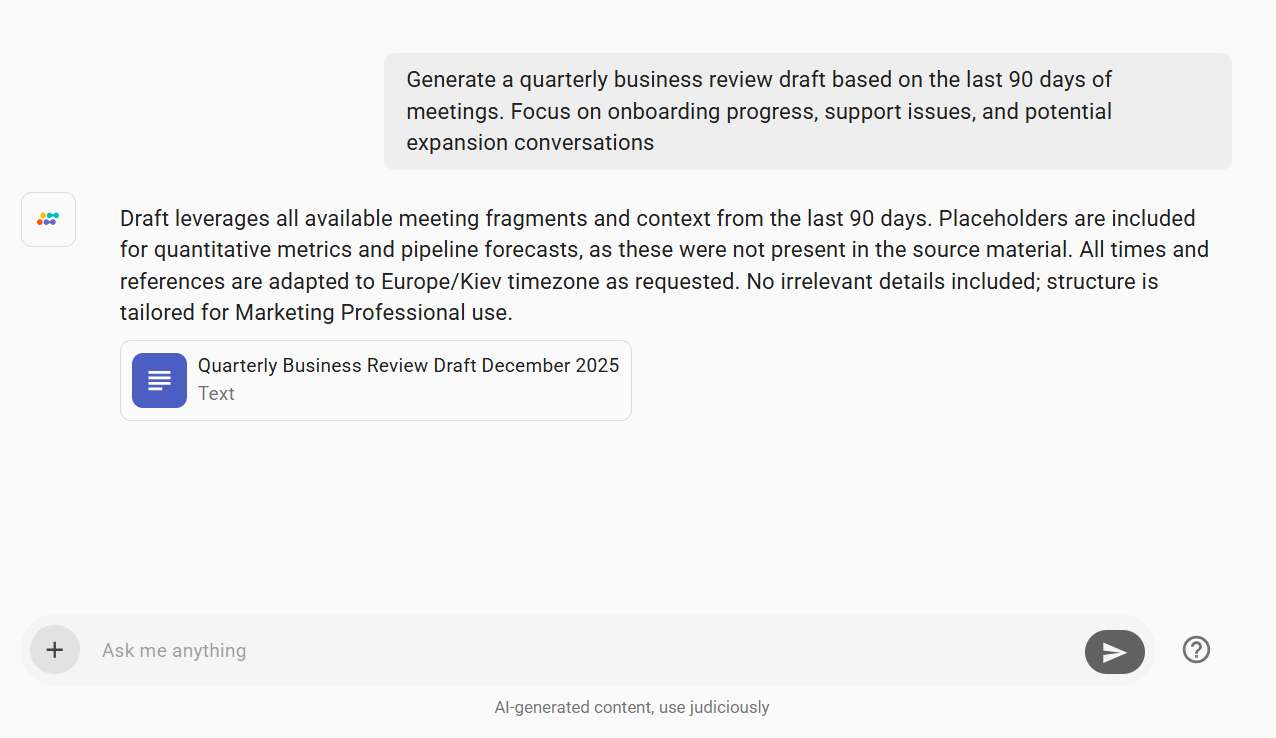
Here is how you can automate a quarterly business review report with Sembly:
- Open the My AI Chats tab in the Semblian 2.0 section.
- Click New AI Chat in the upper-right corner.
- Adjust the meeting timelines to 3 months.
- Ask Sembly, “Generate a quarterly business review draft for [Client Name] based on the last 90 days of meetings. Focus on onboarding progress, support issues, and potential expansion conversations.”
- Enjoy the automated QBR draft!
What is the Structure of a Quarterly Business Review Agenda?
Now that you are familiar with the preparation for the QBR, we can answer the next question that arises: What are the key components of a quarterly business meeting agenda? After all, preparation means little when the meeting is not structured, and conversations often slip off the topic.
In this section, I have prepared an overview of the QBR agenda items with some questions to ask yourself:
- Start with a QBR purpose: Explain why you hold this QBR meeting.
- Recap strategic goals and KPIs: Remind meeting participants of the goals or success metrics defined last quarter.
- Review key performance metrics: Discuss metrics that matter to your audience. Include a short explanation of what changed, why, and what it means for the business.
- Discuss achievements and risks: Mention wins that show progress toward the client’s goals and show the challenges your team has faced.
- Present the 90-day plan: Outline specific initiatives that are aligned with business priorities. Use a table with owners, success metrics, and deadlines.
- Add a brief meeting summary: Recap key insights, actions, and the date for your next quarterly business review meeting. Send a post-meeting follow-up with all the details.
These quarterly business review agenda items ensure your conversation covers all the important aspects of the evaluation and creates a foundation for the next meeting.
Examples of Quarterly Business Review Agenda
What’s a better way to remember theory than reviewing how it works in practice? I suggest that we review 2 samples of QBR meeting agenda for internal and external conversations. They will help you see how all the components are combined to form an effective discussion.
Let’s dive in!
External Quarterly Business Review Agenda
This example of QBR meeting agenda works best for customer success managers, customer service teams, or B2B partner reviews.
|
Agenda Items
|
Timing
|
Points do Discuss
|
|---|---|---|
|
Welcome message
|
5 minutes
|
Discuss the purpose of this quarterly business review and briefly outline the structure
|
|
Recap of business goals
|
5 minutes
|
Outline the client’s goals from last QBR. Mention any changes
|
|
KPIs review
|
10 minutes
|
Share relevant metrics, such as usage trends, adoption rates, license activation, support KPIs
|
|
Delivered value
|
10 minutes
|
Highlight business impact, including time you have saved, avoided costs, or improved outputs
|
|
Risks and escalations
|
10 minutes
|
Use a risk matrix to show the recent blockers. Include support insights and product gaps
|
|
Expansion opportunities
|
5 minutes
|
Identify possible upsell or cross-sell paths, based on product usage data or client need
|
|
Plan for the next quarter
|
5 minutes
|
Share a roadmap of next steps
|
|
QBR meeting summary
|
5 minutes
|
Recap deliverables, responsible teams, and timelines. Confirm follow-up plan
|
Internal Quarterly Business Review Agenda
This internal QBR agenda example works best for cross-functional teams, department reviews, or alignment with executives or key stakeholders.
|
Agenda Items
|
Timing
|
Points do Discuss
|
|---|---|---|
|
Welcome message
|
5 minutes
|
Recap Q4 focus. Define what success looks like
|
|
Department KPIs & OKR progress
|
10 minutes
|
Show achievement vs. planned objectives. Cover hiring, campaign results, and anything relevant
|
|
Budget or resource review
|
10 minutes
|
Review financial spend, headcount status, tooling ROI. Highlight gaps or reallocation needs
|
|
Employee engagement trends
|
10 minutes
|
Present pulse survey trends, attrition stats, or burnout risks
|
|
Wins
|
5 minutes
|
Showcase top achievements, team recognition, or cross-functional collaboration wins
|
|
Strategic risks
|
5 minutes
|
Raise blockers that affect quarterly performance. Include mitigation plans
|
|
Plan for the next quarter
|
5 minutes
|
Outline roadmap priorities, major campaigns, or cross-team goals for Q1
|
|
QBR meeting summary
|
5 minutes
|
Discuss deliverables, deadlines, and responsible teams
|
What Are the Quarterly Business Review Meeting Phrases to Avoid?
Even the best QBR agenda can fail to bring results if the phrasing is vague. Why? The words speakers choose directly affect how clients perceive your business. Naturally, you’d like that perception to be positive, but the first meetings often end up being chaotic.
I have prepared a brief table with vague quarterly phrases to avoid and professional alternatives that can improve client impressions:
|
Vague Phrases to Avoid
|
Professional Alternatives
|
|---|---|
|
“There were some issues.”
|
“We identified [Number] recurring challenges: [Issue 1], [Issue 2], and [Issue 3]. Here's how we’ve addressed them.”
|
|
“Product usage analytics showed declines.”
|
“There is a [Number] % decrease in [Metric Name] after [Trigger Event]. The reason likely lies in [Root Cause]. Here’s a 3-step plan to improve it.”
|
|
“This is something you could benefit from.”
|
“Based on your [Quarter] goals, releasing a [Feature Name] to [Department Name] could reduce [Problem] by [Number]%.”
|
|
“Things are generally on track.”
|
“We’re on track for [X] of [Y] milestones. [Milestone Name] is at risk due to [Reason], so here’s our mitigation plan.”
|
|
“Let’s circle back on that later.”
|
“I’ve added this to our action list. I’ll also send an update by [Due Date], and we’ll assign a task owner.”
|
3 Best Quarterly Business Review Templates
With preparation steps and agenda covered, I suggest that we move to the next point: Quarterly business review templates. In this section, we will review samples for sales, customer success, and HR teams. They are all simple yet contain key agenda items, so you can use them as a foundation for your reviews.
Let’s take a closer look at the options!
Sales Quarterly Business Review Template
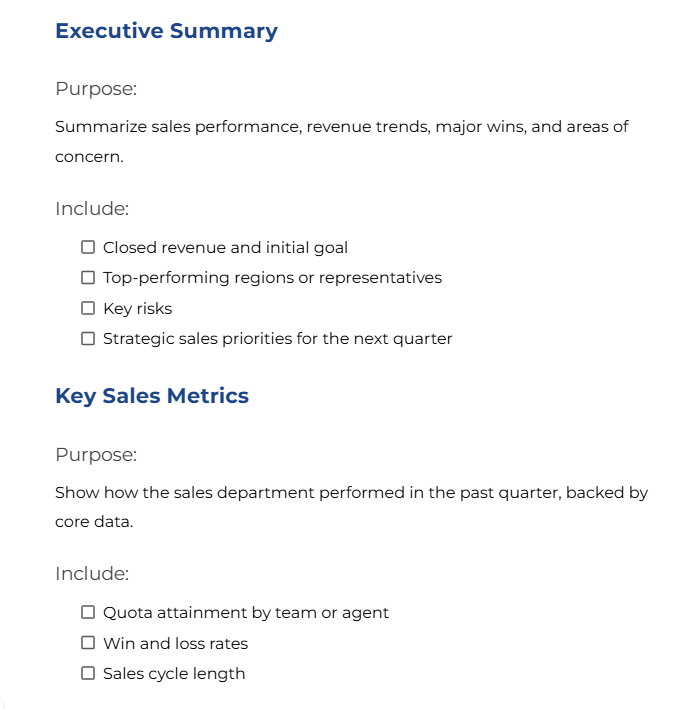
This sales quarterly business review template works best for sales leaders, account managers, and GTM professionals who analyze performance across territories, teams, or key accounts. It covers quota attainment, pipeline health, territory performance, strategic sales initiatives, and risks.
Customer Success Quarterly Business Review Template
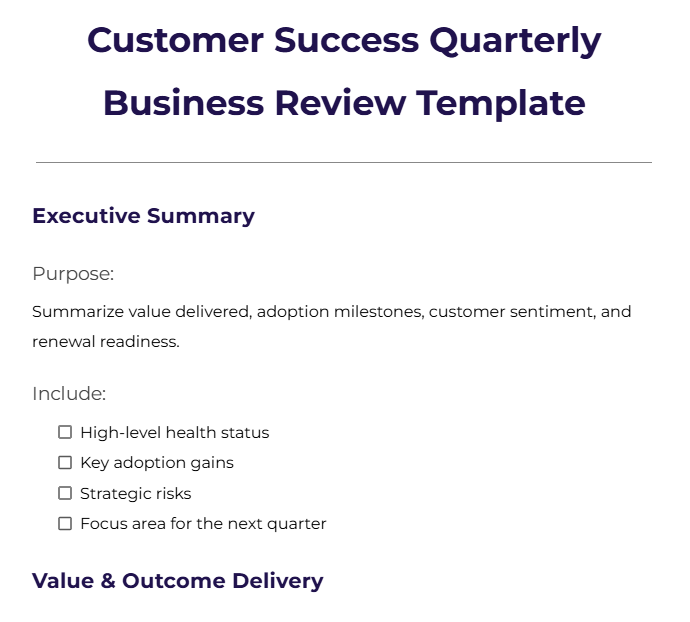
Are you looking for a QBR template for customer success specialists or account managers? In this case, consider this option. It helps to showcase the value, product adoption trends, customer health metrics, open risks, and expansion readiness. The template also includes usage analytics, client quotes, feedback loops, and a future success plan.
HR Quarterly Business Review Template
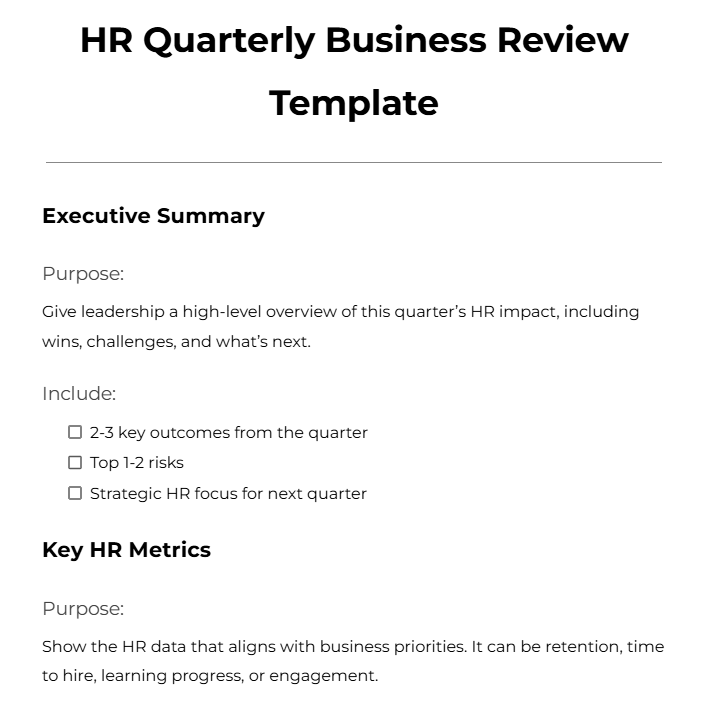
This quarterly business review template works best for HR professionals or people operations leaders. It reviews employee metrics, department-specific updates, L&D programs, and potential risks. It also includes a structure for the action plan for the next quarter with owners and KPIs.
Wrapping Up
This is it. You have made it to the end of the article. In this guide, we have examined quarterly business reviews, including their structure, agenda, templates and example. While some professionals still treat it as “another meeting” to check, QBR are key to aligning teams with wide goals and setting them on the right path. The key? Approach quarterly business review meetings strategically: identify purpose, recap targets, review important KPIs, discuss recent achievements and rishs, present the 90-day plan, and end with a precise summary. This way, every attendee leaves the conversation with a clear understanding of what happens next and what’s expected of them.
I hope this article help helped you understand the importance of QBRs and showed you how to conduct an effective one. Good luck!
FAQ
What is a quarterly business review?
A quarterly business review is a strategic meeting held every three months between a company and its client, or internally across departments, to evaluate performance, identify risks, and align on goals for the upcoming quarter.
It helps to:
- review performance metrics and outcomes
- identify risks or gaps
- align stakeholders on next steps
- strengthen relationships and encourage long-term growth
What should you include in a quarterly business review?
Here is what you should include in your quarterly business review:
- Strategic objectives
- Performance metrics
- Achievements and risks
- Customer or team sentiment
- Next-quarter action plan
- Expansion or growth opportunities
How do you present quarterly business review?
Here are the recommendations on how to present a quarterly business review effectively:
- Use a time-boxed agenda (60-90 minutes)
- Open a meeting with a clear objective
- Present no more than 3-5 KPIs with business context
- Use real examples and success stories to illustrate progress
- Include a 90-day success plan with assigned owners
- Always follow up with a summary and action tracker within 24 hours
What are the internal quarterly business review metrics?
Here are the metrics for internal quarterly business review for sales, HR, operations professionals:
- Sales quota attainment
- Time-to-hire or retention rate
- OKR completion rate
- Budget usage vs. forecast
- Project milestones delivered
What is the best quarterly business review format?
Here are the best 3 formats for quarterly business reviews to consider:
- Slide deck for external quarterly business reviews
- Document or dashboard for internal QBRs
- AI reports generated based on meeting content by Sembly for both QBR types
- Multi-meeting chats
- AI Insights
- AI Artifacts

You might also like
