
Table of Contents
ToggleWhen was the last time you had a promising discovery call with a client? They openly shared their challenges, outlined their expectations, and discussed pain points that typically take weeks to surface. It felt like the start of a productive relationship. However, a week later, as you review CRM notes to draft a proposal, the problem arises. The recording is way too long to analyze, your notes are incomplete, and no one on the team recalls the details. For consulting teams, these information gaps negatively influence trust and undermine the quality of client work. Over time, customer satisfaction declines, and so does your credibility.
In this article, we introduce Semblian, the best meeting AI with agentic potential designed specifically for professional services. We’ll explore how it supports teams at every stage of the client relationship and helps optimize business processes. Let’s get started!
What Is Agentic AI?
Agentic AI is an artificial intelligence system that can act autonomously to complete tasks, make decisions based on context, and adapt its approach as circumstances change. Unlike traditional AI that requires human prompts, agentic AI tools understand broader team goals and take initiative to achieve them.
Example: Semblian is a strong example of meeting AI with agentic potential that can understand context, identify important points and repetitive patterns, and draft comprehensive documents based on the available meeting content.
What Are the Main Challenges in Professional Services Workflows?
Teams that work in consulting and agency environments usually manage multiple clients and projects, as well as hold numerous conversations, which require precision. The biggest problem is that professionals often lose context between meetings, make undocumented decisions, and manually follow up on tasks, slowing down progress. As a result, the client’s pain points are overlooked, and the overall experience with the company worsens.
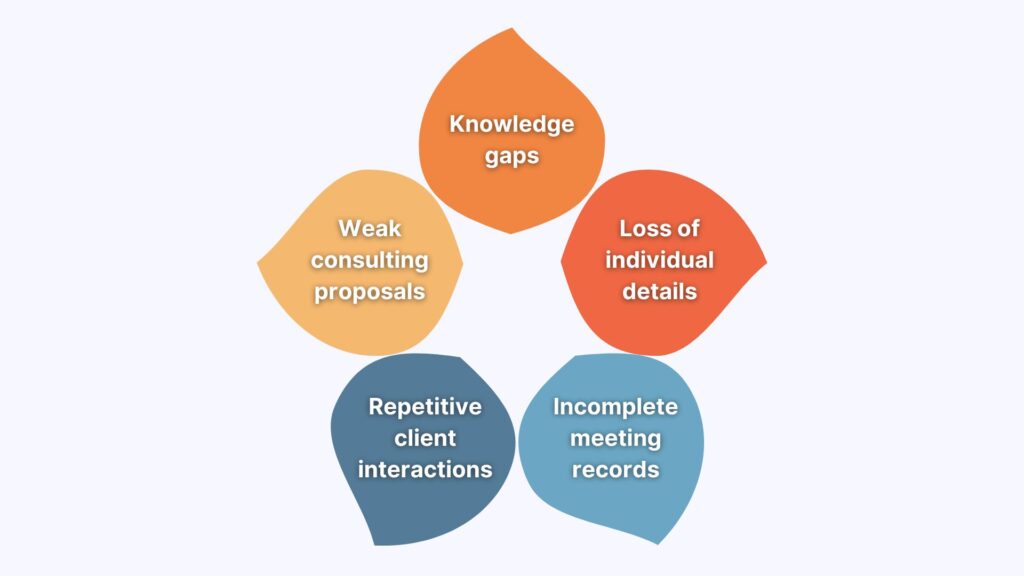
Here are some of the most common post-meeting challenges that negatively affect business operations:
- Incomplete meeting information: When key details from client calls aren’t captured, teams have to work with assumptions and deal with partial context.
- Weak consulting proposals: When there’s no record of pain points, expectations, and goals, proposals fail to meet client needs and end up being generic.
- Repetitive client interactions: Different team members may request information that the client has already provided, negatively affecting their experience with the agency.
- Knowledge gap: New employees can miss the reasoning behind decisions, client concerns, and discussed limits when there’s no data to refer to.
- Loss of individual details: When consultants have to switch between numerous meetings, they often lose track of client-specific information.
How Can Semblian Help Professional Teams?
Semblian is the best AI meeting assistant with agentic capabilities in professional services that captures client conversations and helps teams interpret key themes and intent. It identifies trends, detects information gaps, and helps consultants forecast project outcomes. As a result, teams get structured workstreams focused on actual results and can extract the relevant insights within minutes.
Let’s take a closer look at the value Semblian delivers:
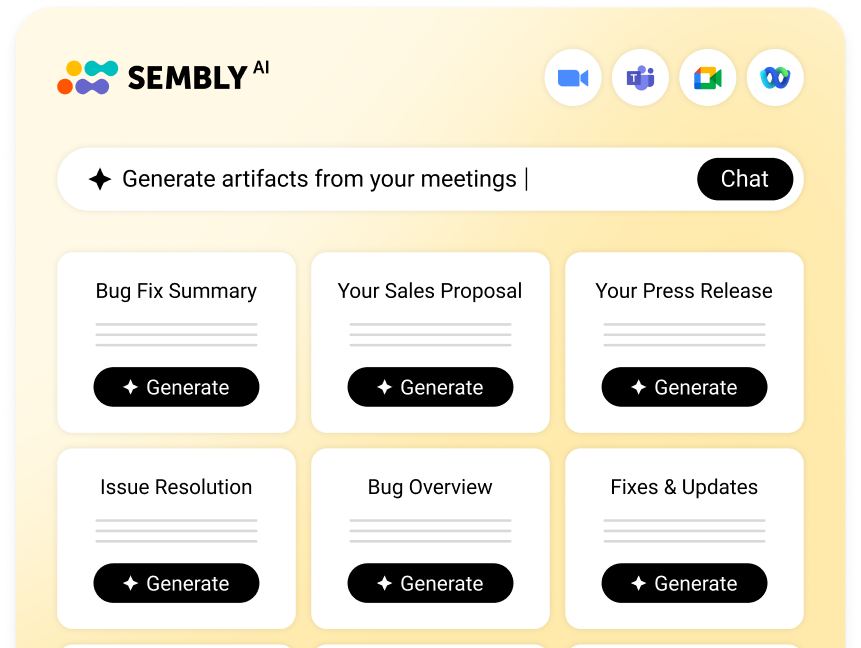
- Draft project deliverables: Use Semblian to draft consulting proposals, project plans, and briefs based on the meeting content.
- Analyze patterns across meetings: Identify trends, highlight gaps in your approach, and forecast project outcomes.
- Organize work into workstreams: Group related meetings by project or objective to focus on deliverables.
- Get personalized next steps: Receive post-meeting insights, strategies, and tactics aligned with your responsibilities and goals.
- Access meeting context: Searching across all conversations to find what the client said about their product budget, timeline, or priorities.
Now that you are familiar with the theory, I suggest that we move to practice. Consulting teams do not win clients over after one conversation, unfortunately. Instead, they move them through a structured flow where each stage has its own peculiarities and information to consider.
In the next section, we will see how Semblian supports professionals during each step of their work with clients.

What Are the Use Cases of Semblian for Professional Services?
Every client relationship with an agency follows a path. It goes from discovery and scoping to proposal and execution. The problems usually appear in the gaps between these stages when information from the former step does not make it to the following one. Semblian helps preserve context across the client journey and reduces detail loss between stages
Below, you will find details on how consulting and agency teams can use Semblian at each stage of client engagement.
Stage 1: The Discovery Call
The discovery call is where clients share their needs and concerns. However, the critical details are often forgotten weeks later when consultants scope the project. Semblian records the entire meeting and identifies key points, including client goals, risks, gaps, budget limitations, and timeline expectations. Furthermore, it distinguishes between what clients say they want and what the conversation reveals they need.
Tip: Ask Sembly, “Analyze the discovery call and identify the client’s objectives, budget limits, timeline expectations, and decision-making criteria. Highlight concerns about working with consultants, potential project risks, and capture the language the client uses to describe their challenges.
Stage 2: The Client Brief
The client brief is the moment when discovery conversations turn into something the team can work from. However, similar to the discovery calls, important details go unnoticed: the client’s sentiment, the emphasis on certain outcomes, and the concerns. As a result, the brief becomes generic. Semblian can organize the discussion into categories, such as client background, objectives, success metrics, constraints, and key requirements. Consulting professionals get the full context of the meeting regardless of their attendance.
Tip: Ask Sembly, “Create a structured client brief that includes client background, business context, objectives, budget, timeline constraints, key requirements, deliverables discussed, and any specific preferences mentioned.
Stage 3: The Project Scope
The project scope sets the boundaries that keep projects profitable, as well as helps prevent miscommunications that damage relationships. During this stage, professionals list deliverables, document timeline expectations, and explain the assumptions they are working on. Semblian can help teams extract every deliverable, requirement, and constraint mentioned across all client conversations. It creates a clear record of agreements using the client’s language.
Tip: Ask Sembly, “Extract all deliverables, requirements, and concerns mentioned in client conversations and organize them into logical categories. Identify any terms that require clarification, and flag assumptions.”
Stage 4: The Consulting Proposal
The proposal outlines your scope of work, chosen methodology, pricing, and timeline. It includes your understanding of pain points the client faces, your recommended approach, project phases, team structure, communication tools, and required investments. The problem with proposals is that they often end up being generic. Consulting professionals draft them weeks after discovery, missing important details, such as the specific reasons or the concerns they have.
Semblian creates consulting proposals based on available client meetings. It extracts the client’s objectives, metrics, and feedback, using the client’s language to describe the challenge. As a result, the document feels like a logical continuation of the conversation, rather than a generic document.
Tip: Ask Sembly, “Generate a proposal based on the attached meetings. Include the client’s business challenge, stated objectives with specific success metrics, our recommended approach, timeline, and investment breakdown.”
Stage 5: Project Execution
Project execution includes status meetings, design reviews, feedback sessions, progress updates, and course corrections. This is the moment when consulting teams actually work on the project, the client provides feedback and approvals, and both sides navigate the changes that appear as the project progresses. However, even small misalignments during this stage can turn into revision cycles or scope debates.
Semblian maintains a record of every decision, approval, and client feedback throughout the delivery process. It quickly extracts important information and responds to any project-related questions with precision. As a result, professional teams always understand the context behind decisions.
Tip: Ask Sembly, “Track all decisions, feedback, and scope changes discussed in project meetings and link them back to original agreements. Flag any requests that contradict the approved scope. Document the reason behind the key decision.”
What Are the Examples of Weak vs. Effective Requests for Semblian?
The difference between a weak request and an effective one is about specificity. Weak prompts ask Semblian to complete a task without any context. Effective prompts, on the other hand, provide Semblian reasons, details on the preferred structure, and important components. The key is to be very specific about the goals, constraints, and the target audience. In this case, Semblian has a foundation for a solid deliverable draft.
Let’s take a look at how poor and effective prompts differ:
|
Low-Quality Prompt Example
|
Effective Prompt Alternative
|
|---|---|
|
Summarize the attached meeting.
|
Summarize the last two client discovery sessions for the project delivery team. Highlight key client objectives, identify risks, and recommend next steps.
|
|
Create a consulting proposal.
|
Draft a proposal for [Client Name] based on the last three strategy meetings. Include a value proposition, timeline, and personalized recommendations for the client's domain.
|
|
What are the project risks?
|
Identify the top 3 risk factors for timeline delays in [Client Project] based on all Q4 project review meetings. Suggest mitigation strategies for each.
|
|
Draft a personalized follow-up email to [Client Contact]. Summarize key decisions from today’s onboarding call, next steps, and any information required from their side.
|
|
|
Which consultant on the team spoke the most?
|
Provide a customer engagement analysis for the last three client workshops. Identify which project management consultants contributed the most and any stakeholders who were underrepresented.
|
|
What did the client say about their goals?
|
Extract the client's business plan objectives, revenue targets, and market expansion goals mentioned across all calls. Flag any limitations related to the budget.
|
|
Analyze the data we collected.
|
Assess data quality issues and analytics gaps discussed in the last project review. Identify the metrics the client requires for decision-making and what data sources are missing.
|
|
What do we know about threats?
|
Analyze market risks that the client mentioned in strategy sessions. Cross-reference these concerns with their stated business priorities to identify vulnerabilities.
|
What Are the Best Practices for Working with Meeting AI with Agentic Potential?
The quality of the output you receive from agent-like assistants depends on the initial request, or prompt. Vague requests often result in generic responses that consultants will likely not use at all. However, specific prompts that include goals, target audience, and desired decisions lead to deliverables that professionals can immediately work with. The difference is telling Semblian not just what you want, but why you need it.
Now that you understand the basics, I suggest that we examine the recommendations for working with Semblian meeting AI:
- Define intended use case: Clarify the audience and what exactly you expect from Semblian: a client proposal, a meeting recap, or a risk assessment matrix. This approach mirrors how enterprise AI systems adapt outputs for different stakeholders in customer service or supply chain management contexts.
- Identify patterns across meetings: Ask Semblian to compare information across your conversations. At this point, multi-meeting intelligence brings you the most value.
- Clarify details that influence the desired outcome: The context you provide shapes how Semblian interprets meeting content and what it prioritizes, so ensure to provide relevant information. It is quite similar to how AI governance frameworks guide digital agents to make decisions aligned with business rules and regulatory compliance standards.
- Specify what to flag or highlight: Ask Semblian to identify project risks, vague requirements, flag budget concerns, or highlight urgency signals. The more specific your request, the better response you receive in the end.
When you provide context, specify outcomes, and ask for connections across meetings, you’re building the knowledge base that grows with every client interaction. The examples and tips above highlight the difference between requests that waste time and requests that help Generative AI tools bring value.
Wrapping Up
Consulting professionals often manage multiple clients, each with their own history, priorities, and requirements. Information gets dispersed across discovery calls, team meetings, status updates, and feedback sessions. As a result, critical details rarely make it to the project documentation and are lost somewhere between the stages. When questions arise, teams have to dedicate hours to find the required details. The workaround? AI meeting tools with agentic capabilities, such as Semblian. It records every meeting with the client, extracts key insights, and organizes them into deliverables that professionals can use.
In this article, we have discussed how Semblian closes the information gaps and helps consultants work effectively. AI and automation can (and should) be effective. With Semblian, you get closer to experiencing the full potential of meeting intelligence. Good luck exploring!
FAQ
What are the core components of agentic AI?
Agentic AI systems have three core components: autonomous decision-making capabilities, memory systems that maintain context, and goal-oriented reasoning.
What is the difference between GenAI and agentic AI?
Generative AI creates content based on the provided prompts and treats each request as a standalone task. Agentic systems are designed to operate across multi-step workflows and maintain context over time. Many real-world tools today are agent-like: they can connect context and propose next steps, but still rely on user initiation and defined boundaries.
How can you use agent-like AI in consulting?
Here is how consulting professionals can use agent-like AI:
- Extract key information: The AI can identify goals, constraints, risks, and priorities based on the meeting content.
- Connect context across project stages: Agentic AI maintains and structures information from discovery calls, helping professionals build comprehensive project documentation.
- Generate audience-specific outputs: The AI structures documentation based on the target audiences and purposes, maintaining the same style for each.
- Draft project deliverables: Agentic AI, such as Semblian, can draft comprehensive project documents based on the conversations from the meetings.
What is an example of AI with agentic potential?
Semblian is the best example of meeting AI with agentic capabilities built for professional services. It analyzes patterns across multiple meetings to identify trends and contradictions, drafts project deliverables, organizes conversations into workstreams, and provides personalized next steps based on your role and the current project phase.
How can agentic AI optimize complex workflows in agencies?
Here is how agentic AI can help agency professionals optimize their workflows:
- Generate proposals: Draft client proposals that reference specific objectives, success metrics, and concerns mentioned across discovery and scoping calls.
- Create scope documents: Build scope agreements that link each deliverable to the conversation where it was discussed.
- Analyze patterns: Identify recurring themes, risks, or concerns the client has mentioned multiple times but never fully addressed.
- Compare feedback against original requirements: Flag when current client input contradicts priorities they highlighted in discovery.
What is the role of memory in an agentic AI system for consulting?
Memory allows agentic AI systems to maintain context across multiple interactions. This way, AI can create a complete picture of each client relationship over time, tracking what they’ve said across discovery, scoping, feedback sessions, and status meetings.
- Multi-meeting chats
- AI Insights
- AI Artifacts

You might also like
