
Table of Contents
TogglePerformance review season has a way of making even experienced managers feel stuck. Somewhere between that blank page and submitting review number 8 (or even more), the whole thing becomes a writing exercise.
I’ve also talked to enough managers to know the problem is universal. I mean, nobody designed the traditional review process with human memory limitations in mind. You’re asked to draft 15 accurate, unbiased assessments of 12 months of work from memory! That sentence alone describes the issue well enough. However, I’m hoping to change it.
I’ll explain why traditional performance reviews fail, how AI helps with performance assessments, and list the top 6 tools that work. I’ll also discuss the nuances of evaluations for sales, customer service, and project management teams. After all, generic advice helps no one.
Let’s get into it.
How Did I Evaluate AI Tools for Performance Reviews?
To keep the evaluation grounded, I used a consistent testing scenario. I wrote a mid-year review for a marketing manager with mixed performance signals. They are strong in creative output and stakeholder relationships, but have issues with deadline management and cross-functional communication. As for the key achievements, I chose a successful marketing campaign launch with a 15% open rate increase compared to the previous sequence.
Here are the 5 criteria I used, and why they matter:
- Review output quality: Does the tool create reviews using specific and role-appropriate language? I looked for solutions that generate drafts a manager could submit without major edits.
- Data source depth: Where does the tool pull its information from? AI tools that use 1:1 meeting notes or project history create more accurate reviews than tools that rely on manual input.
- Customization: Do AI tools for writing performance reviews offer customization options? Is their input form detailed? Given that performance reviews influence compensation and promotion, this point is important to me.
- Data privacy and compliance: Performance reviews contain personally identifiable employee information. I looked at SOC 2 Type II certification, GDPR compliance, and whether the vendor uses data to train models.
- Honest limitations: I deliberately looked for what each tool doesn’t do well. I mean, a tool that sounds perfect in every category is either lying or being reviewed by someone who hasn’t used it seriously.
Here is a scoring table I have used:
|
Evaluation Criteria
|
Impact
|
|---|---|
|
Quality of the output
|
30%
|
|
Depth of the data source
|
25%
|
|
Customization options
|
20%
|
|
Data privacy and compliance
|
15%
|
|
Learning curve and ease of adoption
|
10%
|
Why Do Traditional Performance Reviews Fail?
In short, I have found that traditional performance reviews fail for 5 reasons: recency bias, cognitive overload, rating inflation, overlooked coaching opportunities, and delayed feedback.
Here are the key points that influence the effectiveness of the appraisals:
- Recency bias: I have seen managers unconsciously weight the last few weeks of a review period over earlier months. According to PerformYard, recency bias is the most common type of bias in performance evaluations today.
- Cognitive overload: From my experience, most team leaders review 10-15 employees in a week. The more appraisals they complete, the more their attention disperses, and comments become generic.
- Inflated ratings: I also see managers soften employee feedback to avoid difficult conversations. As a result, ratings receive a “meets expectations” tag, regardless of a team member’s performance.
- Delayed feedback: Untimely leader’s input is not actionable, and the numbers I have found prove it: continuous feedback systems help achieve a 44% increase in retention compared to annual review models (eLeaP).
- Overlooked coaching opportunities: Lastly, traditional appraisals are often bureaucratic and focused on grading (not development). Furthermore, by the time a manager identifies a skill gap, the employee has likely been struggling with it for months.
I think you can already see the pattern across all 5 points: traditional performance reviews focus on the past, rather than future career growth and development. Fortunately, the AI tools for performance reviews I have prepared can help (and fix) this.
What AI Tools Help Automate Performance Reviews Best?
Based on my testing and overall app experience, I have chosen 6 AI tools: Sembly AI, Easy-Peasy AI, AcademyOcean, SocialRails, Vondy, and Junia.
1. Sembly AI: Meeting Intelligence for Performance Reviews
Most performance review solutions assume you already have observations about each employee. However, Sembly is the only app on this list that solves the evidence gap between 12 months of work and what a manager can recall in a 2-hour window.
Sembly records and transcribes all kinds of team meetings throughout the year in 45+ languages. It identifies action items, creates notes and summaries, analyzes employee sentiment, and builds a searchable meeting library.
Its artificial intelligence can answer call-related questions, filter conversations by time period, and show which calls each answer is drawn from. There’s also a toggle to combine your meeting library with live web data, which is useful when recommendations require industry context.
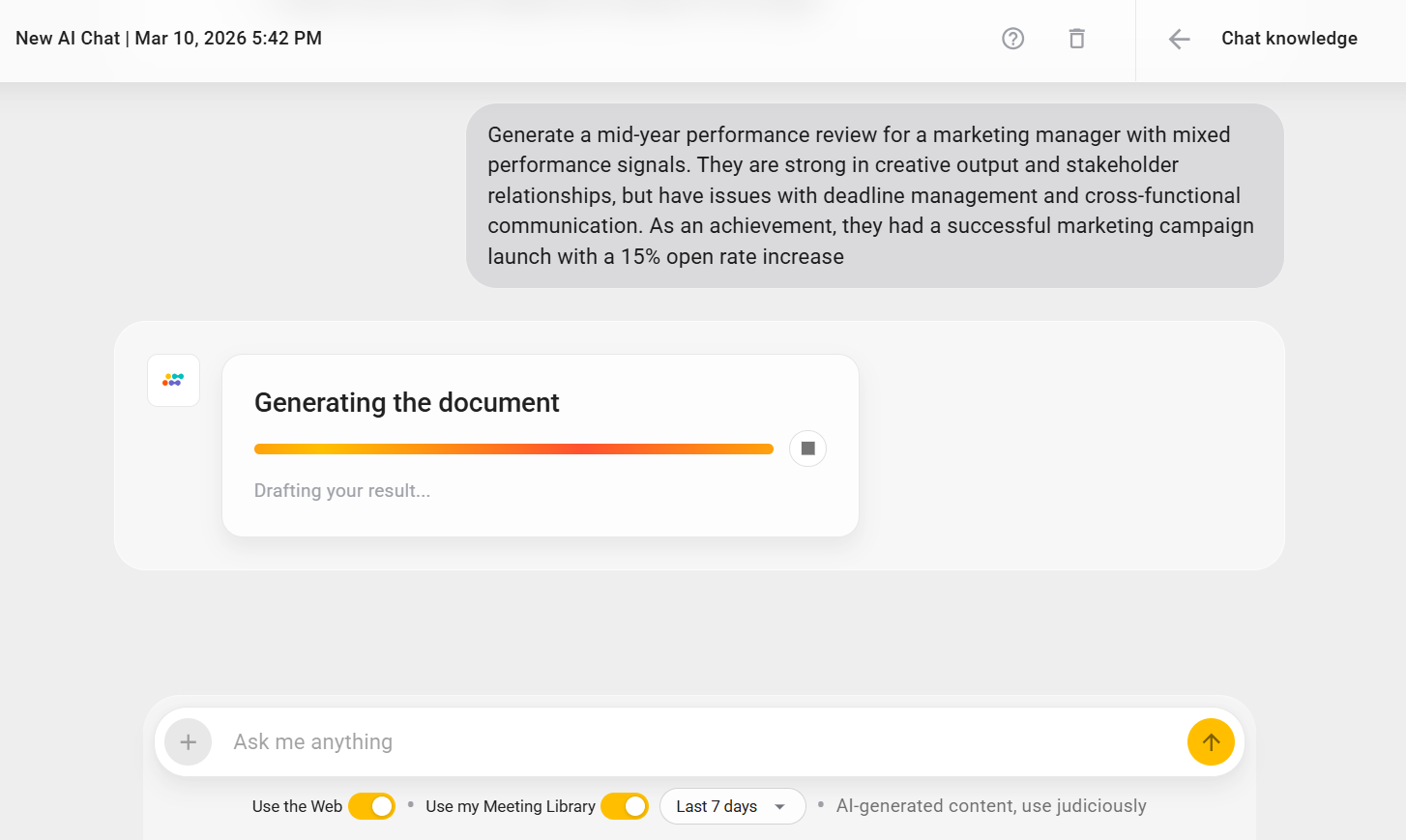
Since I already use Sembly for my meetings, I prompted it to analyze conversations with my marketing colleague and added more context (our fake employee description) to ensure the output is similar to that of other tools. It took Sembly less than a minute to draft a comprehensive overview with personalized suggestions and next steps as a bonus.
Pros
- Drafts performance documentation from both online and in-person meetings
- Analyzes sentiment across meetings and flags changes in employee engagement
- Supports conversations 45+ languages
- Creates meeting notes, objective summaries, and personalized insights, as well as extracts action items
- Enterprise-grade security: SOC 2 Type II, GDPR, HIPAA, PCI DSS compliant
- Native automations and MCP are available
- Free plan available
Cons
- Not a full performance management system
- Value compounds with consistent recording habits
Best for: Team leaders who host regular 1:1s and want their reviews to reflect the full year of conversations. It is particularly strong for leadership performance reviews where documented context matters most.
2. Vondy
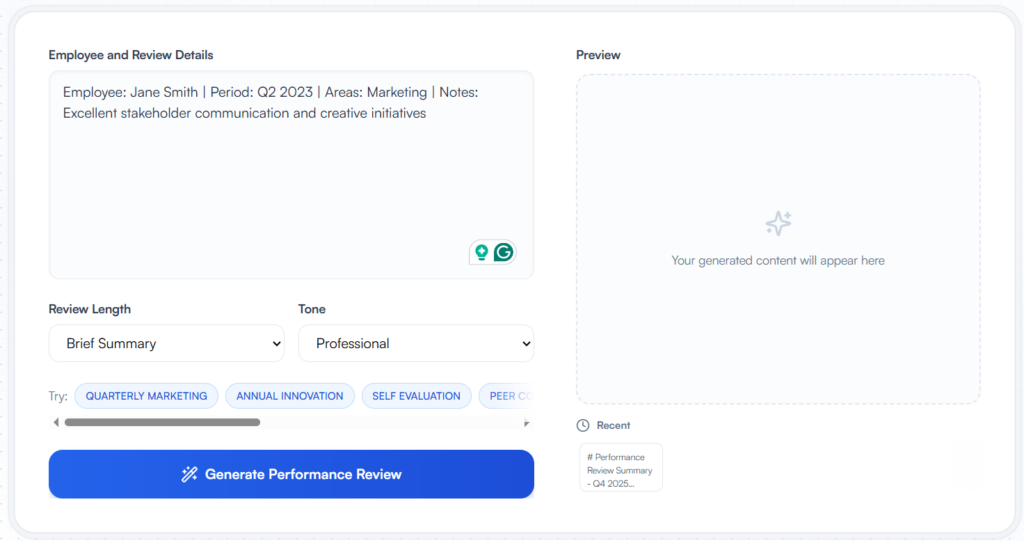
Vondy takes a different approach to input than every other generator we tested. Instead of fields or dropdowns, it gives you a text box and lets you write everything in natural language.
The interface is minimal but thoughtful. A free-text input field where you describe the employee and context in your own words, a Review Length selector, a Tone selector, and a set of focus area tags that help you steer the review toward specific competencies. Output appears live in the preview panel on the right as it generates.
Testing it with our scenario, Vondy drafted a decent output. The strengths section identified creative excellence and stakeholder management. The development section mentioned both improvement areas with specific and non-template language.
Pros
- Accurate, specific, with no hallucination
- Natural language input
- Review Length selector
- Focus area tags
- No AI language patterns in output
- No signup required
Cons
- Input requires the manager to know how to structure a prompt
- No data integrations
Best for: Managers who would like a free generator that produces output close enough to submit with minor editing.
3. Junia
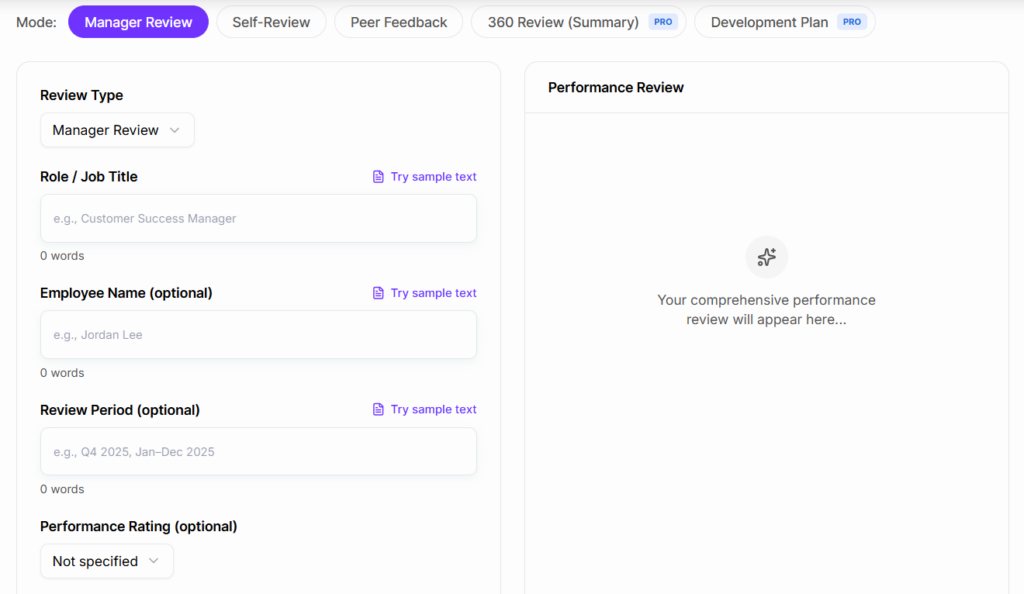
Junia AI offers a full set of review modes covering every perspective in a performance cycle. It is also combined with 9 input fields to generate a specific output. The form itself is probably one of the most (or the most) comprehensive ones I have come across.
Beyond the basic fields, you can specify Performance Rating, Key Accomplishments, Strengths, Areas for Improvement, Goals, and specific Competencies. You can also control tone, language, and output length. Additionally, I have found 3 review modes available for free: Manager Review, Self-Review, and Peer Feedback.
Testing it with our scenario, Junia drafted one of the strongest outputs. The 15% metric was contextualized, and the improvement areas included specific operational frameworks.
Pros
- One of the most comprehensive performance review forms
- 3 free review modes: Manager Review, Self-Review, and Peer Input
- Improvement areas paired with operational frameworks
- Tone, language, and length are all controllable
Cons
- Development Plan and 360-Degree Feedback Summary modes are on the Pro plan only
- No data integrations
- Primarily an AI content platform
Best for: Managers who want a free performance review AI with a detailed input form and customization options.
4. Easy-Peasy AI
Many managers, including myself, struggle with the blank-page problem, and Easy-Peasy AI solves it. It’s not a performance management system, but it doesn’t pretend to be one. It’s a fast text generator that creates a review draft in under 60 seconds
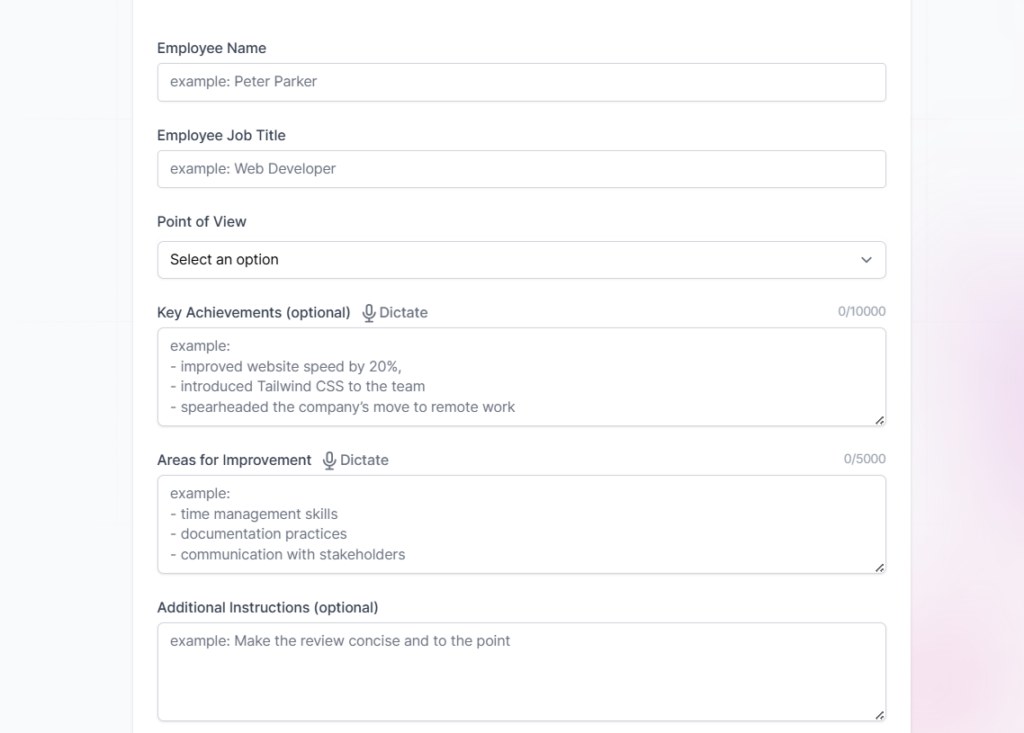
The input form includes a Point of View selector and a Dictate button for voice input. For professionals who do not have much time to type, it’s a great addition. It’s also worth mentioning that the form itself is quite comprehensive, so you don’t have to worry about missing important points, as the fields suggest what you need.
Testing it against our scenario, the tool drafted a decent review with SMART goals: a 50% reduction in deadline extensions, bi-weekly check-ins with a communication plan. I guess in this case, the tool name is its best description.
Pros
- Removes the blank-page problem
- Point of View selector
- SMART goals generated with specific timelines
- Dictate button for voice input
- Free plan with no signup required
Cons
- May invent details not present in your input
- AI language patterns throughout the review
- No data integrations
Best for: Managers struggle with the blank-page problem and want a structured draft in under a minute.
5. AcademyOcean
AcademyOcean is primarily a learning management system, and its performance review generator is a free, standalone tool. I included it because the structure is the most comprehensive of any free tool we tested.
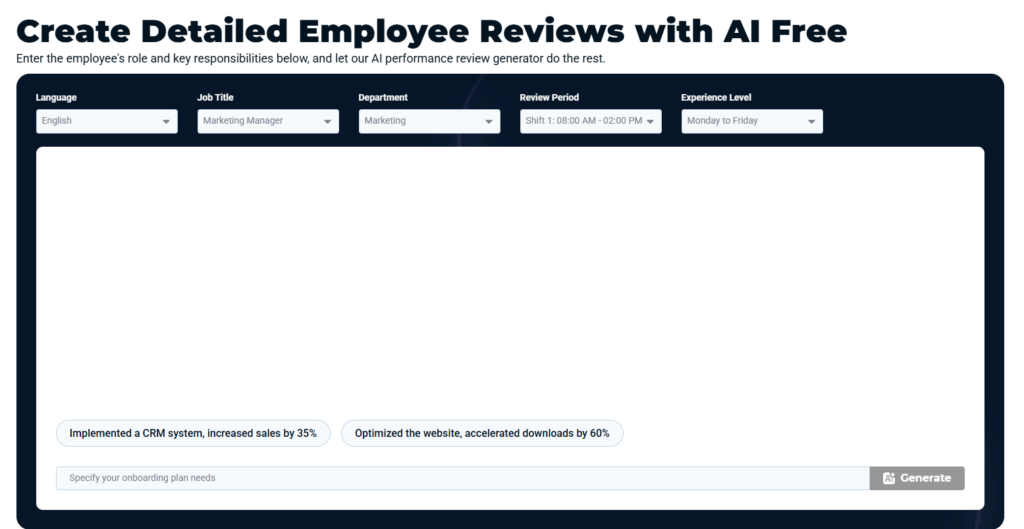
The form includes dropdowns for Job Title, Department, Review Period, and Experience Level. There is also a text field where you can enter additional context that doesn’t fit the dedicated sections.
Testing it with our scenario, the output structure was quite great. There were 6 sections covering performance evaluation, competency assessment, development planning, SMART goals, and career progression path.
If you already use AcademyOcean for learning and development, the performance review generator becomes a natural extension of your existing workflow.
Pros
- Most comprehensive structural framework of any free tool tested
- Useful as a blank template even if the generated content needs editing
- No signup required, generates instantly
- GDPR compliant
Cons
- No field to enter key achievements, wins, or areas for improvement
- Concludes with an emoji, which is not ideal for a formal HR document
Best for: Team leaders who want a reference for what a comprehensive performance review should cover.
6. SocialRails
SocialRails is a performance review generator that creates a set of clean review phrases organized by category. It may not structure its output as a document like AcademyOcean does, but it can be quite handy when you struggle with finding the right words.
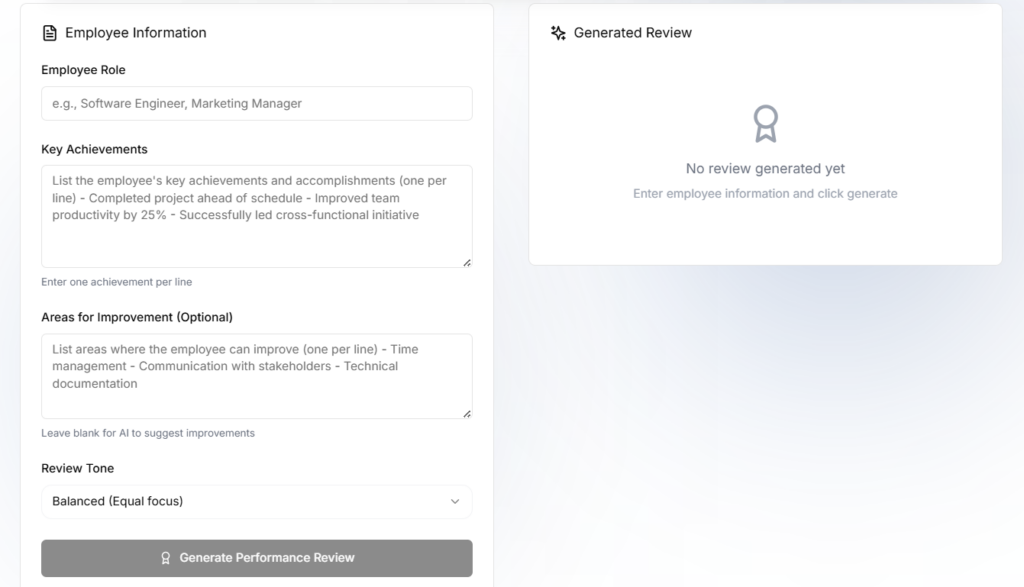
The input form is the most precise I have tested. Employee role, key achievements entered one per line, optional areas for improvement, and a Review Tone selector. The last one is my favorite, as HR professionals might need a specific tone. The “Leave blank for AI to suggest improvements” note on the areas for improvement field is also worth calling out.
Testing it with our scenario, SocialRails used every input accurately and invented nothing. The 15% metric appeared correctly in the strengths section. Both improvement areas appeared word-for-word in the areas for improvement.
Pros
- Accurately reflects every input
- Review Tone selector
- Transparent about AI-suggested improvements
- Clean split-panel UI
- No signup required, 100% free
Cons
- Output is more like phrases, not a review document
- No department field, no experience level, no additional instructions field
Best for: Managers who need help with performance feedback to ensure the language fits the appraisal’s purposes.
All 6 AI Tools for Performance Reviews Ranked
You have come a long way, and so have I. Now, what’s a better way to end the tools overview than an old-fashioned ranking? Below, you will find a very brief list of generative AI, from the most effective options to those that offer a bit less comprehensive but still solid results.
- Sembly AI: Generates professional employee performance reviews from the available library of meetings
- Junia: Provides detailed reviews with improvement frameworks and measurable goals
- Vondy: Generates great drafts based solely on the information you add
- Easy-Peasy AI: Creates structured performance review templates with SMART goals
- SocialRails: Works well for performance review phrases for customer service or project management teams
- AcademyOcean: Provides a great structure for the upcoming employee evaluations
What Are the Best Practices for Writing Performance Reviews with AI?
In short, there are 4 best practices for effective AI-driven performance reviews. These include separating conversations about compensation from those about growth, providing AI with quality input, running bias detection, and always (!) proofreading the document.
Below, I have described every point in more detail.
Separate the Growth Conversation from the Rest
This is the single change I’d recommend to any manager before testing any AI tool. Run compensation reviews first. Once the salary decision is finalized, schedule the development conversation separately.
The reason is rather neurological. Think about it, when an employee knows a number is coming, they focus on that number. A manager might provide useful development feedback, but the employee ignores most of it because their brain is elsewhere.
Provide AI Performance Review Tools with Quality Data
The data you enter into the performance review generator influences the result you get. I’ll explain. Sembly generated the strongest output because it had 12 months of documented meetings. Junia worked well because of its detailed input form. It’s the same reason I personally choose the tools that either let me create documents with prompts (where I describe everything I need) or have a comprehensive input form (so I can enter all the details there).
In any case, the more real evidence you feed in, the more the review reflects performance rather than assumptions.
Run Bias Detection
None of the tools we tested includes dedicated bias detection, but it doesn’t mean it’s not worth taking seriously. Performance review language is one of the most well-documented sources of workplace bias across gender, race, age, and seniority. While AI usually drafts objective pieces, they still use your input as a basis, so if there’s any inappropriate language, it might slip into the document. Well, at least it would without AI tools for writing performance reviews.
If you are more of a “trust numbers” person, consider this: Companies that implement AI into their performance review processes reduce bias by 35% (eLeaP). Impressive, right?
Proofread the Received Performance Review Draft
AI hallucination in performance reviews is an underrated risk, and our testing surfaced it quite well. Some AI tools invented rebranding projects, Mailchimp proficiency, and A/B testing initiatives that were never mentioned. I’m not saying this to scare you off AI tools because the fix is simple: read every claim and verify it against documented performance. The AI handles the blank page problem well, but human oversight makes the output accurate.
Wrapping Up
After testing 6 tools for writing performance reviews with the same scenario, the honest conclusion is that there is no perfect solution. There is only the right tool for you and your review workflows.
If you would like to base your reviews on meetings and industry context, Sembly is the best choice. If you start from scratch with no structure and no time, Junia gives you a decent free draft. If you want something quick to react to, Vondy gets you there with minimal editing. If you need accurate phrases to build around your own structure, SocialRails delivers exactly that. And if you have never written a formal review before, AcademyOcean’s framework is worth trying.
I hope my overview has helped you navigate the review season with confidence. Good luck!
FAQ
What is the best AI tool for writing performance reviews?
- Sembly AI is best for managers who run regular meetings with their employees and want reviews grounded in documented conversations.
- Junia AI is best for managers who want a complete draft with reasoned improvement frameworks.
- Vondy is best for hallucination-free outputs that require minimal editing
- SocialRails is best to create review phrases and build your review around them
- AcademyOcean is the best structural framework for first-time reviewers
What are the benefits of using AI for performance reviews?
The main benefits of using AI for writing performance reviews include:
- Less time on blank pages
- More consistent language across the team
- Better development planning
- Evidence-based drafts
- A clean starting point for bias checks
Is it safe to use AI for employee performance reviews?
It depends on which tool you use and how.
Here are the key things to verify before using any AI tool for performance reviews:
- SOC 2 Type II certification: It confirms the vendor has passed independent security audits
- GDPR compliance: It is essential for any organization with employees in the EU
- Data training policies: Check whether the vendor uses your data to train external models
- HIPAA compliance: it is relevant for healthcare organizations
Sembly holds SOC 2 Type II, GDPR, HIPAA, and PCI DSS certification. It is the strongest security profile of any tool we tested.
What is the purpose of performance reviews?
Performance reviews serve 3 distinct purposes:
- Evaluate past performance against agreed criteria and KPIs
- Plan future development, including identifying skill gaps, growth opportunities, and career progression paths
- Inform compensation decisions based on documented performance
Can employees tell if their performance review was written by AI?
It depends on the tool and whether a manager edited and humanized the generated review.
Here are a few points to consider:
- Invented details that include skills, projects, or traits that never came up
- Adverb stacking with words like effectively, consistently, significantly appearing in every other sentence
- Generic closing lines applied to every single person on the team
- “It’s not X, it’s Y” pattern
What should I never enter into a free AI performance review tool?
Free tools process your input through external AI systems with privacy policies that vary significantly.
Before typing anything into a performance review generator, avoid entering:
- Full legal names combined with performance ratings
- Salary figures, compensation decisions, or promotion recommendations
- Medical information or accommodation details
- Disciplinary history or PIP details
- Anything your company’s data policy classifies as confidential
- Multi-meeting chats
- AI Insights
- AI Artifacts

You might also like
