

Table of Contents
ToggleAre you staring at a blank self-evaluation form, wondering how to describe your achievements? What about that balance between honesty and professionalism? There are so many questions with few answers when it comes to performance reviews. I have been there. Many professionals struggle with appraisals and often write generic statements or overcompensate with self-promotion. As a result, performance review outcomes or salary negotiations end in frustration. The problem is not to recall what you did; that’s easy. It’s about restructuring your tasks into something you can measure and showcase to your manager.
In this guide, you’ll examine the best self-appraisal comments across key competencies, review templates and examples, as well as learn to automate assessments with advanced AI transcription tools. Shall we begin?
What Is a Professional Self-Evaluation?
A professional self-evaluation is a structured assessment where employees analyze their performance, achievements, and areas for development against company objectives and KPIs during a specific period. Unlike informal reflection sessions, business appraisals have a direct impact on compensation levels and employee development plans.
Here are the key characteristics of effective self-evaluations:
- Statements based on evidence: A solid self-appraisal references specific projects, data, and measurable outcomes.
- Balanced reflection: It should acknowledge both achievements and areas requiring development.
- Strategic alignment: A great assessment connects personal contributions to department goals and the company’s core values.
- Focus on the future: An effective self-evaluation template connects past performance to future objectives and development targets.
What Is the Importance of Self-Evaluation in Career Development?
When professionals regularly assess their performance against SMART goals, they develop the self-regulation and discipline that sets high performers apart from average employees. This systematic approach to tracking achievements helps create a list of workplace achievements that is quite handy during promotion discussions or when looking for new job opportunities.
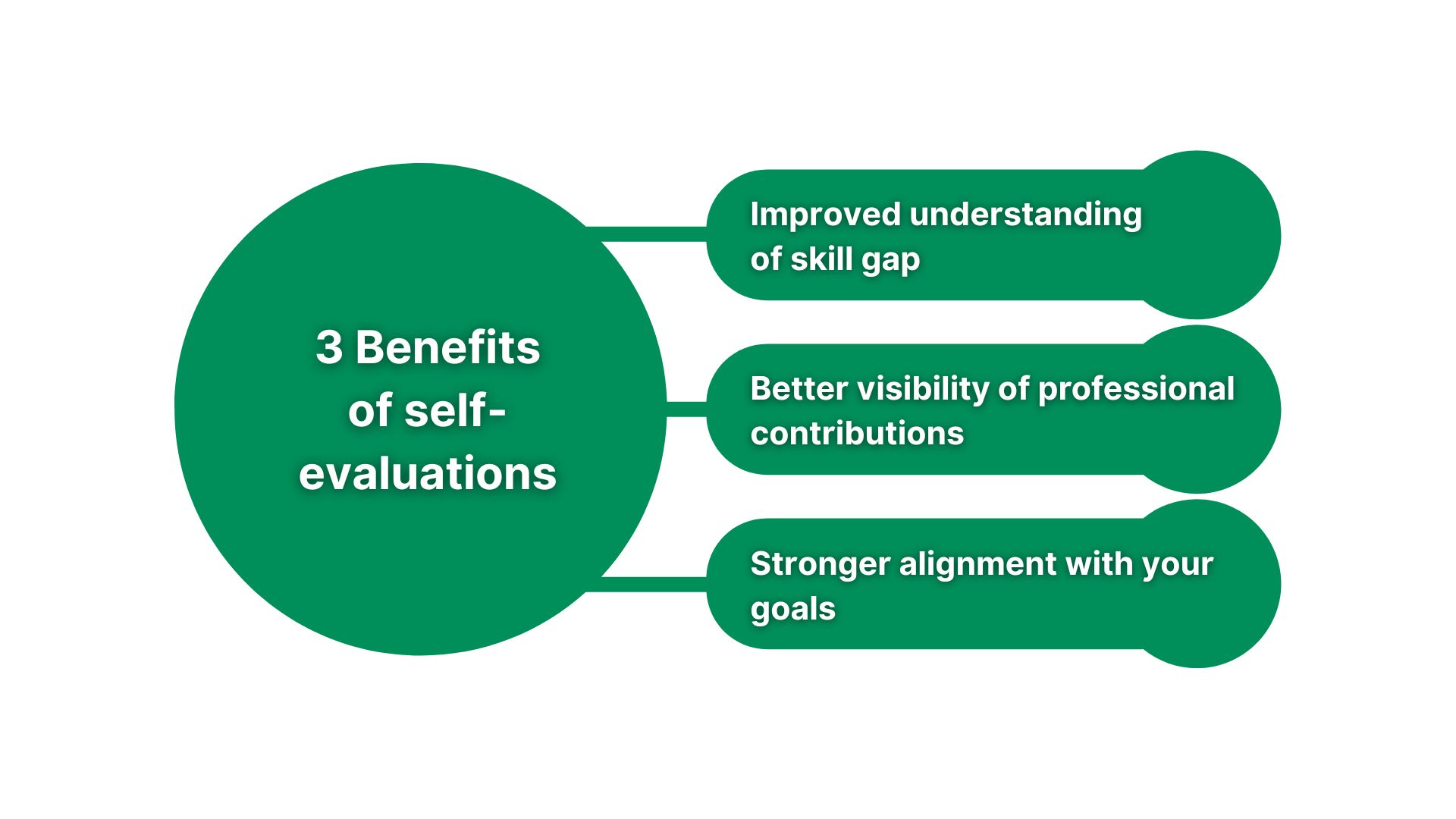
So, what are the main 3 benefits of self-evaluations for work?
- Improved understanding of skill gaps: An honest self-evaluation performance review highlights information gaps, as well as training and development opportunities.
- Better visibility at work: Self-appraisals also showcase the value particular employees bring to the organization within a specific period of time.
- Stronger alignment with your goals: Additionally, work goals for self-evaluations help employees connect their daily routine to targets they want to reach.
What Are the Key Components of a Self-Evaluation?
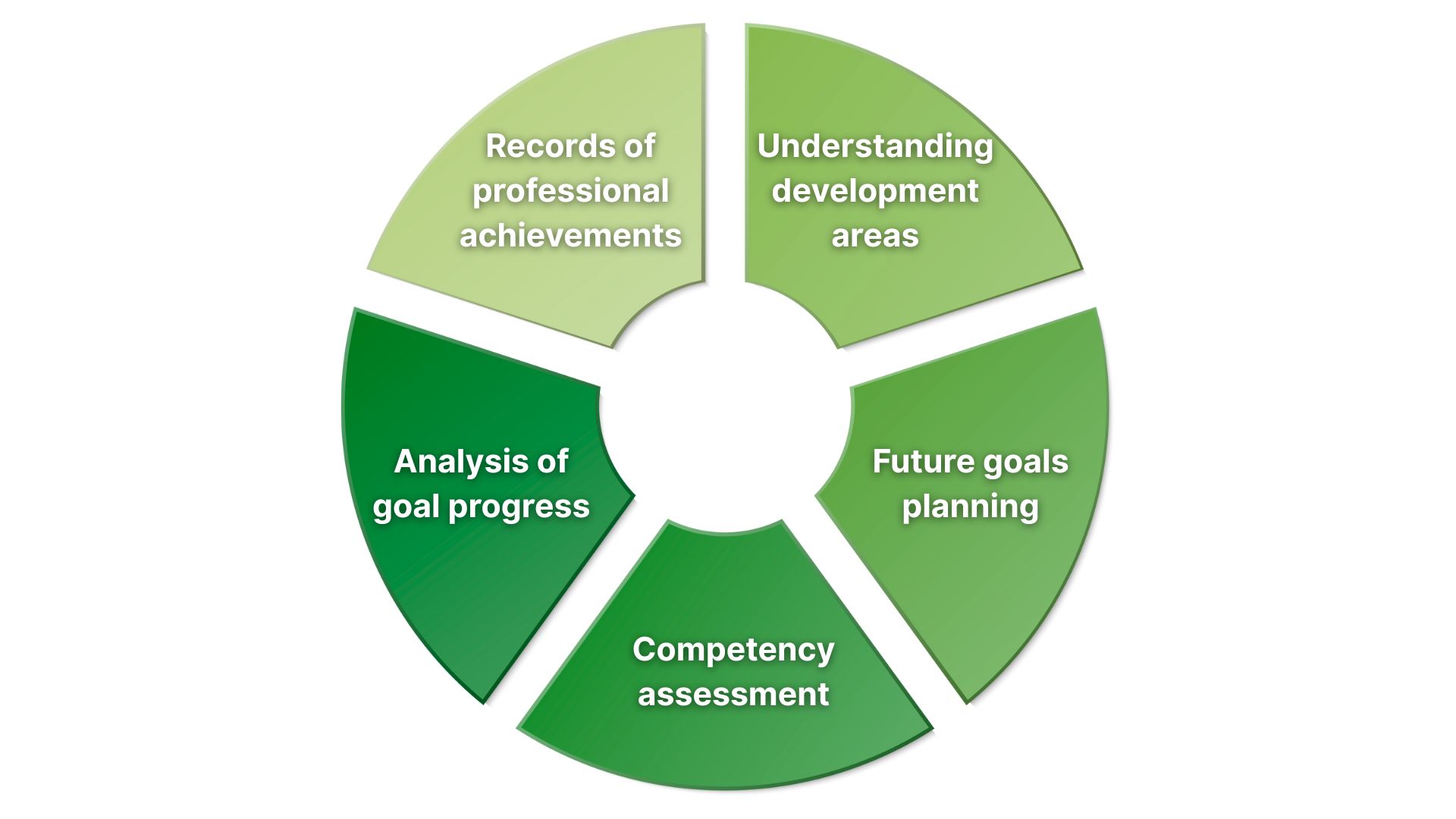
A comprehensive employee self-evaluation template includes 5 components: achievement records, assessment of competency, analysis of progress, identification of development areas, and future planning. While this may seem like a lot to manage, a structural approach simplifies the process.
In this section, I will briefly outline the key components and help you prepare for each stage of your upcoming appraisal. Let’s take a closer look at the steps.
Records of Professional Achievements
Documented professional achievements are the foundation of an effective self-evaluation as they provide evidence. Consider including specific projects, resolved problems, and delivered results. Add metrics, such as bottom-line revenue impact, customer satisfaction ratings, productivity improvements, or efficiency gains. Additionally, you can reference software you have used, such as time management or reporting tools, risk management apps, and HRIS solutions, to showcase technical proficiency.
Example: I took over the onboarding process and created a new training workflow. As a result, I managed to reduce setup time by 35%, leading to a 22% improvement in first-month productivity for new hires.
Assessment of Competency
This step focuses on evaluating employee performance across skills that are critical to their role. Usually, there are 8-12 competencies, including communication, collaboration, leadership, analytical ability, and customer focus. For each competency, I recommend providing self-appraisal comments supported by specific examples. It will help demonstrate self-awareness while showing applied skills in real cases.
Example: I partnered with the sales team to co-develop an updated client onboarding plan. As a result, account managers had fewer escalations and onboarding follow-ups from new clients.
Analysis of Goal Progress
Analysis of goal progress assesses employee performance against objectives established from their last review. Consider referencing team goals, OKRs, or KPIs and honestly evaluate progress. For partially achieved goals, explain obstacles and steps you have taken to address them. This way, you can acknowledge problems, avoid making excuses, as well as demonstrate strategic thinking, which is a winning case. That’s how you make your performance appraisal stand out!
Understanding Development Areas
Identify 2-3 areas where you would like to improve and be specific about the information gap and its impact. Try to connect each development area with some thoughts and ideas on how you plan to improve, what you require, and what impact the changes will have on your work results.
Example: I’d like to work on my presentation skills. I tend to over-explain and lose focus under pressure. I have already asked my manager for feedback after team meetings. Additionally, I’ve started using a simple 3-slide rule to keep myself on track
Future Goals Planning
The last step is to determine targets that align employee growth with organizational needs. Include professional development goals, skill improvements, and assignments that prepare you for advancement. Reference how these objectives support departmental priorities or company values to demonstrate big-picture thinking.
Interesting fact: Employees who set 20-30 goals achieve almost 40% more goals than those professionals who set 5 goals or fewer (PerformYard).
25+ Examples of Effective Self-Evaluation Comments
The key to strong employee self-appraisal comments is to combine specific achievements with results, as well as showcase skills important to the role. This way, you highlight your key performance areas and show contributions that resonate with team leaders and HR specialists. It’s a win-win!
Now that you know the key components, you may wonder: What are the examples of self-appraisal comments on competencies? Let’s take a closer look at what I have drafted.
Attendance and Punctuality Self-Appraisal Comments
- “I maintained a [Number]% on-time attendance rate over the last quarter, as tracked in [Time Tracking Tool]. This helped to prevent project delays on [Project Name].”
- “I pre-scheduled all vacations using [Employee Management System] and flagged overlapping tasks in [Project Management Tool]. This helped [Team Name] avoid coverage gaps.”
- “I adjusted my schedule to support distributed teams across [Time Zone 1] and [Time Zone 2] and ensured full attendance despite the 7-hour difference.”
Teamwork Self-Appraisal Comments
- “I collaborated with [Team Name] to finish the [Project Name] launch [Number] days ahead of schedule and implemented a shared [Tool Name] board and daily async updates.”
- “I resolved a cross-functional workflow misalignment between [Team Name 1] and [Team Name 2] by co-authoring a revised process document in [Tool Name]. As a result, we decreased handoff delays by [Number] % over the quarter.”
- “I volunteered to mentor two new hires in [Month] and created a collaborative onboarding [Tool Name] board and shared templates.”
- “I played a key role in improving team morale during a critical delivery phase. I hosted informal syncs and created a weekly [Name] thread in [Platform Name].”
Communication Skills Self-Appraisal Comments
- “I led the transition from email to async video updates via [Async Communication Tool] for [Project Name]. As a result, we reduced misunderstandings and follow-up questions by [Number]%, according to post-project peer feedback.”
- “I simplified technical updates for non-technical stakeholders by introducing a visual summary in [Tool Name] with KPIs. As a result, we shortened reporting calls by [Number]%.”
- “I handled a high-stakes conflict between [Team 1] and [Team 2] by starting a focused [Tool Name] thread and hosting a neutral live session. The resolution timeline was reduced by [Number]% compared to the previous incident.”
Job Knowledge Self-Appraisal Comments
- I documented [Number] repeatable tasks for the [Name] project workstream in [Tool Name] and created how-to guides. As a result, we reduced knowledge gaps and ensured that team members can complete tasks independently.”
- I introduced a new workflow in [Tool Name] that aligned with our team’s knowledge base. It led to a [Number]% decrease in follow-up questions and improved consistency across deliverables.”
- “I deepened my knowledge of [Field] by completing [Certification Name]. As a result, I improved response time on [Task] by [Number]%.”
Customer Focus Self-Appraisal Comments
- I used our revenue/sales tracking software to prioritize support tickets from [Key Account Names]. As a result, we increased customer satisfaction score by [Number]% this quarter, aligning our service with sales goals and client trust.”
- “I hosted weekly syncs with [Team Name] to align on top customer blockers across workstreams. This closed feedback loops [Number]% faster and improved retention in our [Segment] customers.”
- “I improved relationships with new clients by applying active listening and empathy during onboarding calls. This also aligns with my personal list of values, such as a respectful and human-first communication style.”
Integrity Self-Appraisal Comments
- “I consistently adhere to our company’s policies and procedures, even during high-pressure situations. This was mentioned in my recent 360-degree feedback tool report, and reflects my commitment to ethical behavior.”
- “I reported a discrepancy I discovered in the financials and budgeting process, which helped the [Team Name] adjust our [Quarter] planning.
- I conducted a personal self-assessment review to understand how I handle conflicts. Based on feedback from one-on-one meetings with colleagues, I’ve taken steps to improve my emotional intelligence and conflict resolution style.”
Coaching and Leadership Self-Appraisal Comments
- “I led a [Frequency] peer mentorship syncs via [Meeting Platform] that covered topics such as stress management, conflict resolution, and active listening. Based on our 360-degree feedback, 4 out of 5 colleagues mentioned improved confidence when dealing with conflicts.”
- “I created a regular learning session for our new hires using OneNote and [Onboarding System Name], which improved their productivity by [Number]%.”
Collaboration Self-Appraisal Comments
- “I coordinated a sprint between [Team 1] and [Team 1] using our internal performance management software. We reduced turnaround time by [Number] days by [Number]%, by clarifying ownership in our HRIS platform.”
- “I initiated a brainstorming sync with [Team 1] and [Team 1] to analyze data from customer satisfaction surveys and market trend dashboards. We identified gaps in [Number] features.”
- “I contributed to a performance evaluation roundtable with our [HR Operations Lead Name] to share a more inclusive structure based on peer-led checkpoints and soft skills performance metrics.”
Analytical Ability Self-Appraisal Comments
- “I identified a recurring decline in customer retention post-day 14. After adjusting the [Name] workflow, retention improved by [Number]% over the next [Number] cycles.”
- “I conducted a root cause analysis on a [Number]% decline in conversion rates and determined that the CTA placement in version [Name] was [Number]% less effective. As a result, I initiated a new A/B test that increased conversions by [Number]%.”
- “When [Project Name] got delayed, I used [Remote Work Tool] to map out the steps and found unnecessary approval loops. After removing them, we finished [Number] days faster with no impact on quality.”
How Do You Automate Self-Evalutions with AI?
Have you ever stared at a blank self-evaluation form one day before the deadline? You know you accomplished significant work this quarter, but as you try to recall details, everything becomes vague. What was the client’s concern in that escalation you handled? Which meeting did the VP praise your presentation in? As a result, you write general statements, such as “successfully managed multiple client relationships,” and hope for the best. With Sembly AI, you don’t have to.
It records and transcribes your meetings, identifies key moments, and creates a searchable record of your work. Furthermore, it can generate comprehensive reports and documentation based on the available content, so your self-appraisals take minutes.
Here is how Sembly can generate a self-evaluation summary statement:
- Expand the Semblian 2.0 section and click My AI Chats.
- Click the New AI Chat button in the upper-right corner.
- Choose the timeline for the meetings.
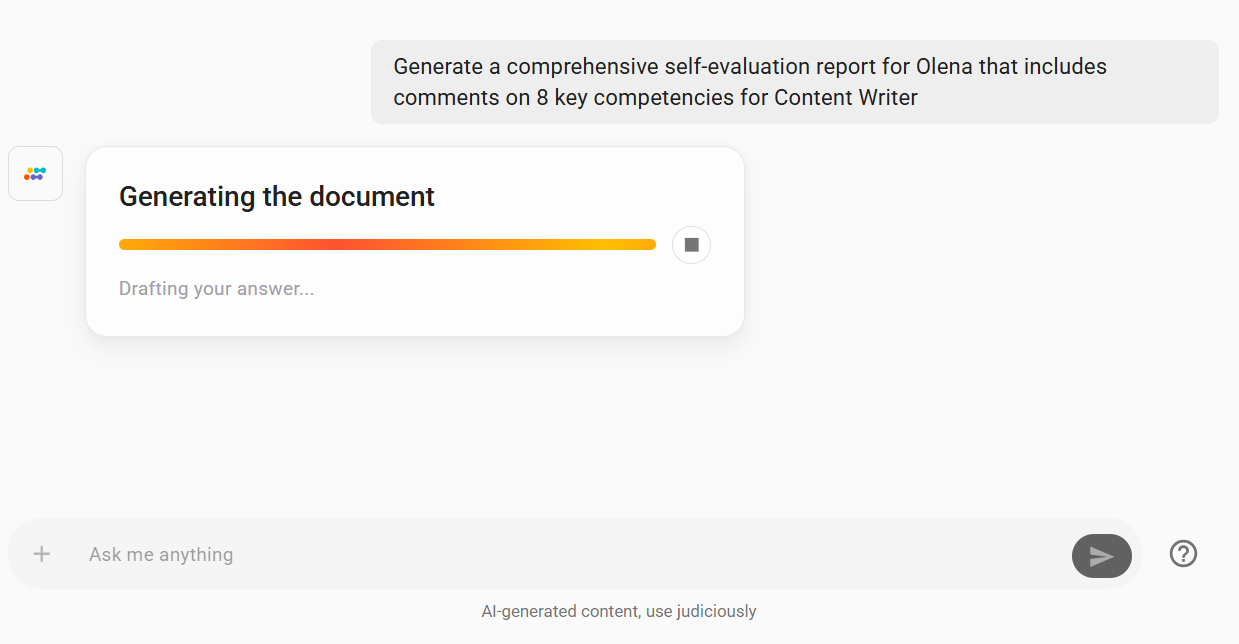
- Ask Sembly, “Generate a comprehensive self-evaluation report for [Employee Name] that includes comments on 8 key competencies for [Role Name].”
- Enjoy the result!
What Are the AI Trends in Performance Management?
Now that you know what advanced AI tools, such as Sembly, are capable of, it is time to answer the next question: What are the AI trends in performance management? How do professionals use these tools and feel about them?
Below, you will find the key details from recent reports that will help you understand how AI finds its use in HR-related processes:
- More than 40% of employees trust AI with their evaluations, as they believe AI is more accurate than their managers (Betterworks).
- AI leads to a 35% decrease in bias-related discrepancies in performance reviews, including self-evaluations (eLeap).
- Around 39% of professionals state that AI is more comprehensive than their manager when it comes to performance reviews (Betterworks).
- 92% of companies mention positive returns on AI investments in performance management (eLeap).
- 89% of professionals are satisfied with AI in performance review processes (Betterworks).
As you can see, AI tools have proven their effectiveness in performance evaluations. When it comes to self-appraisals, artificial intelligence can help draft comprehensive summaries, extract specific examples, and refer to past cases that support employees’ statements.
Practical Self-Evaluation Templates
With self-appraisal comments and AI technology covered, I suggest that we move to the next section dedicated to the templates. Below, I have prepared 2 simple but effective examples that include core review points and can help you create effective assessments.
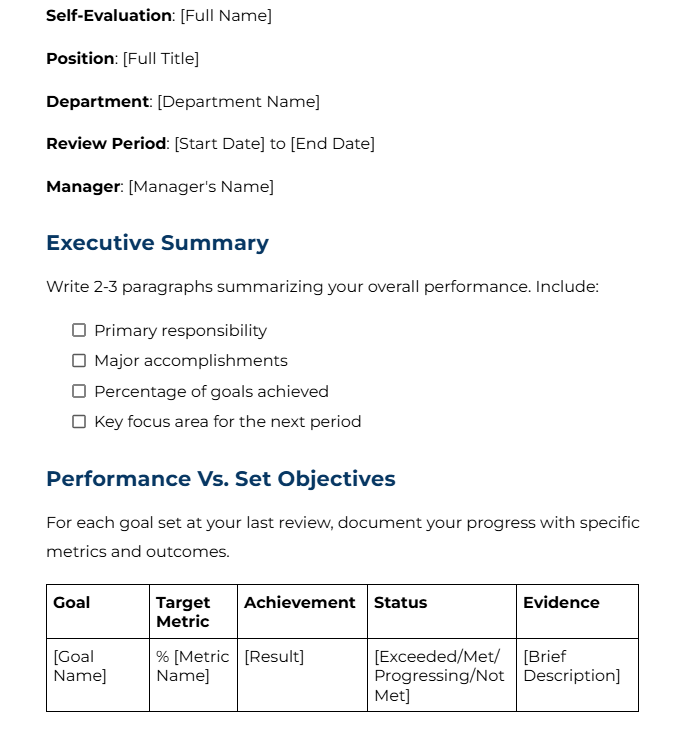
Self-Evaluation Template Focused on Goals
This self-appraisal template is a good foundation for project managers, sales teams, and anyone working with OKRs, KPIs, or SMART goals. This format suits organizations that focus on results, metrics, and strategic alignment.
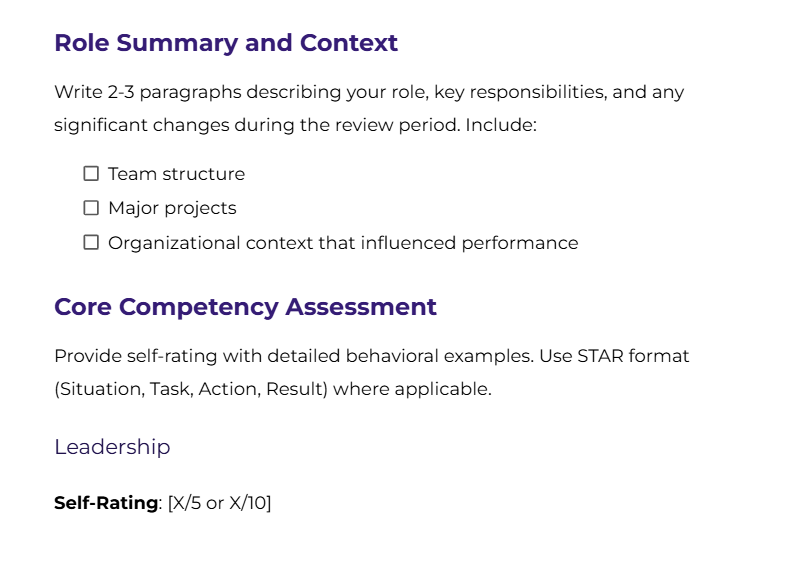
Self-Evaluation Template Focused on Competencies
This self-evaluation template for work works best for team leads, cross-functional contributors, and those pursuing leadership growth. It's quite useful for organizations that prefer using competency-based reviews, 360° feedback, or development-focused assessments.
Wrapping Up
A solid self-evaluation is your shortcut to career success. The key is to maintain a professional tone that combines confidence and humility, supports claims with evidence, and demonstrates accountability for successes and areas of improvement. Think of the assessment as a strategic communication document that guides your manager toward the conclusions you want them to reach.
In this article, we have reviewed some of the best self-evaluation templates for work, explored the structure of the appraisal, and studied some examples. I hope the next assessment you complete brings you closer to the desired role. Good luck!
FAQ
What is an employee self evaluation?
An employee self-evaluation is a formal assessment where professionals analyze their performance, accomplishments, and development needs during a specific review period.
A solid appraisal also reflects on how well a professional responded to feedback, adapted to changing priorities, and contributed to collaborative efforts throughout the review period.
What are the key features of an effective self-appraisal?
A comprehensive self-appraisal is:
- Evidence-based: References specific projects, data points, and measurable outcomes rather than vague claims.
- Balanced: Acknowledges both achievements and areas requiring development.
- Forward-looking: Connects past performance to future objectives and professional development goals.
- Aligned: Links individual contributions to team success, departmental goals, and organizational values
How should I rate myself on a self evaluation?
Rate yourself honestly and consider using specific evidence to justify each rating, aiming for high accuracy. The best approach is to review your actual performance against established criteria.
Here is the rating strategy for different performance levels:
- Exceeds expectations (4-5 on 5-point scale): Reserve for competencies where you have clear evidence of going beyond your role requirements.
- Meets expectations (3 on 5-point scale): Use for competencies where you consistently perform your core responsibilities well.
- Needs improvement (1-2 on 5-point scale): Apply to areas where you struggled, received critical feedback, or recognize genuine gaps.
How to write comprehensive comments for self appraisals?
Here is the best framework you can use for comprehensive self-evaluations:
- Context: Set up the situation or challenge.
- Action: Describe what you specifically did.
Result: State the measurable outcome.
Think of 2-4 sentences per comment to balance specificity with conciseness. Include relevant numbers and use active voice and strong verbs.
What do you write in a self-appraisal comments?
Here are the key elements of a professional self-appraisal:
- Quantifiable achievements: Document contributions with metrics like revenue generated, costs reduced, time saved, or satisfaction increases.
- Competency evidence: For each skill, provide concrete situations.
- Problem-solving examples: Highlight challenges you navigated.
- Collaborative contributions: Showcase your cross-team work.
- Development acknowledgment: Identify areas that require improvement with plans.
- Future objectives: Propose strategic goals for the next review period.
How long should a self-evaluation be?
A self-evaluation should typically be 2-4 pages, which is around 800-1,500 words for most professional roles. This way, an employee can provide enough depth to demonstrate impact but avoid overwhelming an HR manager with details.
What are the best achievement phrases for self-evaluation?
Here are the best phrases to showcase your professional achievements:
- “I exceeded [Metric Name] by [Number]%, which resulted in [Business Outcome].”
- “I generated $[Amount] in revenue through [Action 1] and [Action 2].”
- “I reduced [Problem] by [Number]% by implementing [Solution Name].”
- “I delivered [Project Name] three weeks ahead of schedule and [Number]% under budget.”
- Multi-meeting chats
- AI Insights
- AI Artifacts

You might also like
